
The Day I Worked Nine Hours and Could Not Name What Moved
It was a Wednesday. I closed the laptop a little after seven, sat back, and tried to do something I had recently started doing at the end of each day — name three things that had actually moved forward. Not three things I had touched. Three pieces of real progress.
I sat there for a while. I had been at the desk since just after nine. I had been working — there was no period in the day I could honestly call wasted. I had answered messages, fixed a small problem someone had flagged, drafted the start of an article, joined two calls, looked at a project plan, sent some files, taken a break, come back, looked at the article again, written a few more lines. Nine and a half hours of mostly working. And I could not name three things.
The article was further along than it had been in the morning, but not in a way I would be willing to call moved. The project plan was not decided. The messages were answered but had produced more messages. The small problem was solved, but it was the kind of thing I would not remember by Friday. The day had passed through me. I had been there for all of it. And nothing about it had consolidated into anything I could point to and say: that exists now because today happened.
What bothered me was not the productivity question — I had been having unproductive days for years, and not every day produces something memorable. What bothered me was that the day had not felt unproductive while I was inside it. It had felt like a normal working day. I had been busy. I had been engaged. The shape of it, from inside, was indistinguishable from a day where something real had happened. And that, when I started looking at it, was true of most of my weeks.
The Calendar That Looked Like a Plan and Was Not One
My first attempt at fixing this was the one almost everyone tries first: tighten the schedule.
I time-blocked the whole next week. 8:30 to 9:30, writing. 9:30 to 10:00, email. 10:00 to 11:30, project work. 11:30 to 12:00, review. After lunch, a different block. After that, another. The calendar looked like a serious person's calendar. I felt organized for about as long as it took me to fill it in.
Then Monday started. The first block began on time. The second started fifteen minutes late because the first had run long. The third — the important one — got displaced by a message thread that turned into a small fire. By eleven, the calendar had stopped describing what I was actually doing. By Tuesday, I was not even looking at it.
The story I told myself at the time was that I lacked discipline — the plan was good and I had failed it. So I tried again the following week, with tighter blocks and a stricter rule. That lasted slightly longer before failing the same way. I went through four or five versions, each shorter-lived than the last, before I finally noticed that the strategy itself was the problem.
The full-day calendar did not fail because I was undisciplined. It failed because it was brittle. A plan that requires the whole day to go exactly as written will be broken by the first deviation, and once it is broken, there is nothing left to follow. I had been building structures with no slack, then blaming myself when reality applied any pressure at all.
What I needed was not a better plan for the whole day. The whole day could not be planned that way. What I needed was protection for one part of it — the part where the work that mattered would happen — and a more honest relationship with the rest.
What Scattered Effort Was Actually Producing
Once I stopped trying to control the whole day, I started looking at what was happening inside it — particularly at the cost of how it was structured.
A day with twenty small task switches is not the same as a day with three or four larger ones, even if the total hours of work are identical. The arithmetic is not symmetrical. The reason is something organizational psychologist Sophie Leroy documented in detail: when you switch from one task to another, part of your cognitive attention stays anchored to what you just left. She called this attention residue. It does not fully release just because you have moved on behaviorally. And the more incomplete or emotionally weighted the previous task, the heavier the residue you carry into the next one.
What Leroy's research implies, applied to a normal scattered workday: each switch costs not just the time of the switch itself but the partial degradation of everything that follows it. You arrive at the second task already operating at reduced capacity, then at the third even more so. By the seventh switch, the version of you working on what is in front of you is a depleted version that bears only a passing resemblance to the focused person who scheduled the day.
A related finding from researcher Gloria Mark at UC Irvine, who has spent decades following knowledge workers and measuring how their attention actually behaves: after a digital interruption, the average time to return to the original task at the same level of engagement is about twenty-three minutes. Not seconds. Minutes. If you are interrupting yourself every ten or fifteen minutes throughout the day, you are not running a series of partially recovered work sessions. You are running one long low-engagement session with no recovery at all.
This was what my days had been: long stretches of low-engagement work that felt busy because I was always doing something, and produced little because I was rarely doing any one thing for long enough to enter it properly. The hours I had counted were real. The depth I had assumed they contained mostly was not.
Why the First Block of the Morning Matters Disproportionately
The next thing I started paying attention to was when in the day the productive work actually happened — on the rare days when something genuinely moved. The pattern was specific and consistent. The real progress almost always happened before lunch. Specifically, in the morning, before the day's reactive demands had reached me.
A piece of research that helped me understand this is Teresa Amabile's work at Harvard Business School. Amabile and her colleagues tracked the daily moods, motivations, and outputs of hundreds of knowledge workers over years, asking what predicted a day feeling productive and meaningful versus drifting and frustrating. The single strongest predictor was not time worked, hours slept, or external rewards. It was small, visible progress on work that mattered — and the timing of that progress turned out to matter more than its size. Days that started with concrete progress, made early, kept building. Days that started reactive — email triage, small administrative tasks, putting out other people's small fires — rarely recovered, even when more hours were worked later.
Amabile called this the progress principle, and what it implies for a workday is significant. The first real movement of the day is not just the first item completed on a list. It is the thing that determines whether the rest of the day operates on the momentum of progress or under the drag of having not yet started. The cost of starting reactive is not only the time spent on reactive work. It is that the morning hours — when cognitive capacity is highest and the day's residue has not yet accumulated — get spent on tasks that did not require those hours. By the time you are ready to do the work that mattered, the part of the day designed for it is gone.
This was the framing that finally clicked. I did not need a better calendar. I needed to protect the first stretch of meaningful capacity — the hour when something real could actually move — and treat everything else in the day as a different category of work, to be handled with whatever capacity remained after the important thing had happened.
Why I Eventually Settled on Forty-Five Minutes
The duration question took a few attempts to resolve.
I started at ninety minutes because that was what I had read about — deep work, long blocks, focused immersion. Ninety minutes collapsed. The block was too imposing to start; resistance at the front was too high. When I did manage to start, I would often hit a wall around the seventy-minute mark, a kind of cognitive fatigue that meant the last twenty minutes produced low-quality work I would have to redo. The block was longer than my sustained attention.
Twenty-five minutes, the Pomodoro length, had the opposite problem. Short enough to enter without resistance, but the timer rang just as I was getting somewhere. The transition out, when I was finally in real engagement, broke the engagement I had just managed to reach. Twenty-five minutes worked for shallow tasks. For the kind of work I was trying to protect, it was too short to descend into anything.
Forty-five minutes turned out to be the duration that worked for me. The mechanism became clearer when I read about the work of K. Anders Ericsson, the psychologist who spent decades studying how expert performers actually practice. Ericsson's research on deliberate practice — the kind of focused, effortful work that produces genuine improvement — found that even top performers in their fields could only maintain truly deliberate practice for limited windows, typically around an hour at a time, before quality degraded and rest became necessary. Practice beyond that point was not more deliberate work; it was lower-quality work that masqueraded as the same activity.
Forty-five minutes is below Ericsson's upper limit, which gives the block headroom — it stays genuinely deliberate the whole way through. And it is well above the depth threshold of about twenty minutes, the point below which most cognitively demanding work has not yet entered its deeper mode. Long enough to enter the work and produce something that would not have existed at the end of a shorter block. Short enough that starting does not feel like committing to an endurance event. The specific number is not sacred — forty, fifty, or sixty works for different people. The principle is the same: long enough to enter genuine engagement, short enough to start without dread.
What the Block Has to Produce to Count
The mistake I had been making for the first few weeks, even after I had settled on the duration, was about what I was committing to inside the block. I would write things like "work on article" or "project work" in the slot. I would sit down at the scheduled time. I would open the document. And then I would spend the forty-five minutes near the work without producing anything I could point to at the end.
The block had a duration but no destination. I had been there. The work had not moved.
What changed this was making each block produce a specific, visible result. Not a category — a thing. Not "work on article" but "draft the introduction, three hundred rough words, no editing." Not "project work" but "write the six bullet points that go into the next steps section." Small and specific enough that you can tell, at the end, whether you produced it. There is no version of "I worked on the article" that is complete or incomplete. There is a clear version of "I drafted three hundred words of the introduction" that either exists at the end of the block or does not.
This change connects to research by behavioral scientist Peter Gollwitzer on what he called implementation intentions. Gollwitzer's experiments found, across many different behaviors, that vague intentions ("I will work on this") were poor predictors of follow-through. What predicted follow-through, sometimes nearly doubling completion rates, was specifying the action so precisely — when, where, what — that there was no decision left to make in the moment of starting. The brain did not have to translate "work on this" into something it could actually do. The translation had been done in advance.
A block with a category target requires that translation work every time. A block with a specific output target does not. You sit down, see what you are producing, and start producing it. The specific output also makes the block falsifiable: a yes-or-no question at the end. Either the introduction draft exists, or it does not. Categories are infinitely accommodating — an hour "working on the article" can include nothing that survives scrutiny. The block becomes accountable to itself.
The Five Minutes Before the Block Starts
The block does not begin when the timer starts. It begins about five minutes earlier, when I close everything else.
The mistake I made for a long time was treating the block as something that started when I sat down. But by then, the conditions for it to succeed had already been set. If email was open in another tab, my attention would drift to it. If a chat application was running, the notification badge would pull at the corner of my eye every time anything arrived. If my phone was on the desk — even face-down, even silenced — the cognitive load of monitoring its presence was already running in the background. Sitting down at a workspace built for distraction and trying to enter deep work was a contradiction the block could not resolve from inside itself.
So now, before the block starts, I close the things that should be closed. Email client: closed, not minimized. Chat: closed. Browser tabs unrelated to the work: closed. Phone: in another room. The five minutes of setup is the block's actual beginning — the moment when the conditions for focus get arranged. The forty-five minutes that follow are the part where I use those conditions.
This connects to behavioral scientist BJ Fogg's research on what he called behavior design. Fogg's central finding, after years of working on behavior change at Stanford, was that motivation is unreliable: it varies day to day, hour to hour, depending on factors you do not fully control. The way to make a behavior reliable is not to depend on high motivation. It is to reduce the friction required to perform it until even your worst-case motivation can clear the threshold. If starting the block requires me to first close five applications and put my phone away while I am already feeling resistant to the work, I will not start. If the setup is done — if when I sit down, the workspace is already a place where focused work is the only available option — the threshold to start is just the first sentence. That is a threshold low motivation can usually clear.
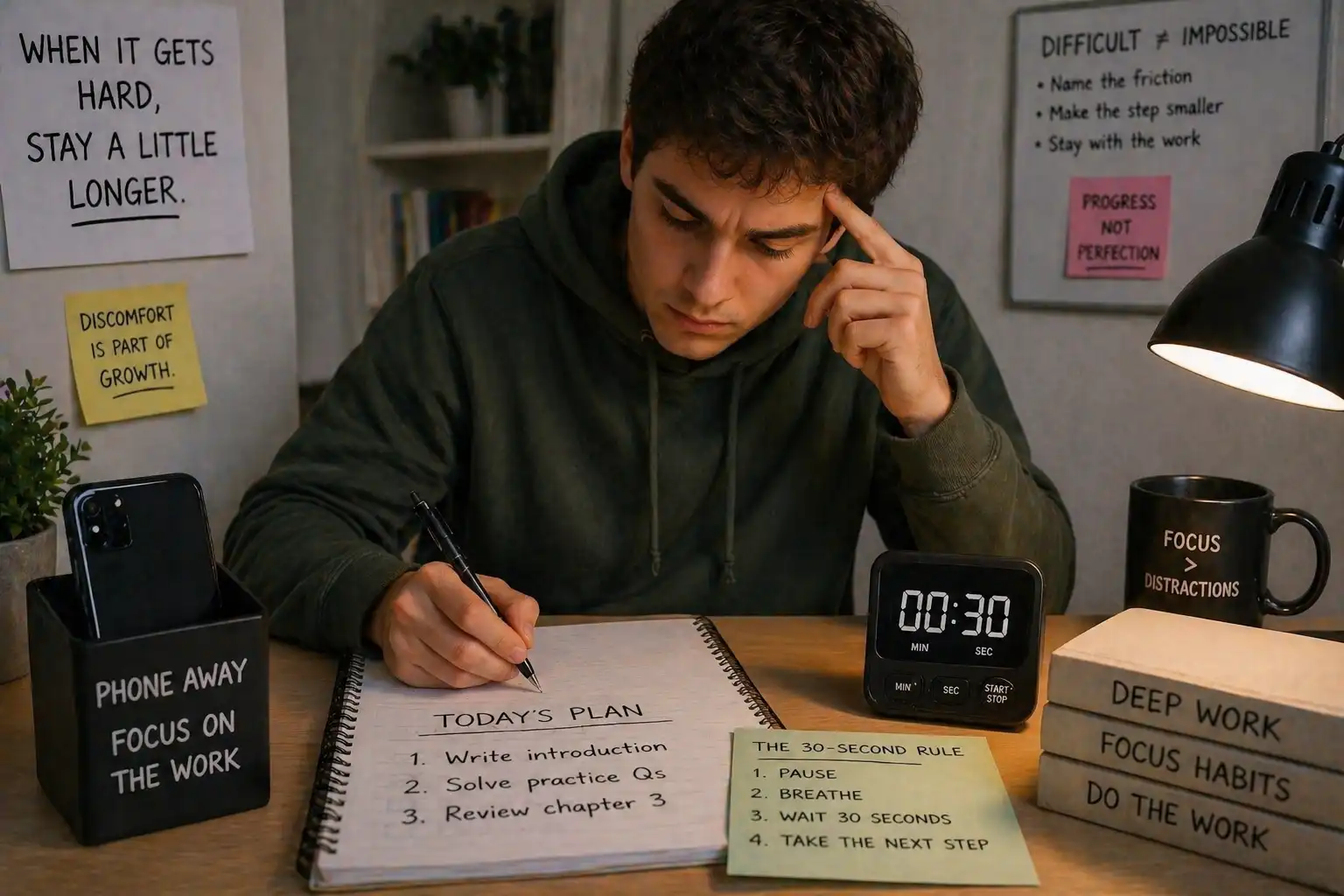
The other thing I do in those five minutes is write the specific output at the top of the document or notebook. Not as a plan. As a target. "Draft introduction: 300 rough words, no editing." The target is visible from the moment I sit down. There is no negotiation about what the block is for. The decision was made five minutes ago, when I was calmer and more decided than I will be inside the block. The version of me at the start of the block does not have to figure anything out. He just has to start.
When the Anchor Block Does Not Work
The block is not a universal solution, and I would be misrepresenting my experience if I pretended it always works. Some honest failure modes.
It does not work when the target is vague. This is the failure I keep returning to because it is the most common. If I write "work on the article" in the morning instead of a specific output, the block dissolves into rereading, fiddling with structure, opening reference tabs, and forty-five minutes pass with nothing produced. The specific output is not optional. It is the structural element that holds the rest together.
It does not work when I schedule it after a meeting. Meetings produce a reactive, social, fragmented cognitive state that does not transition into focused independent work without a long buffer. The residue from the previous interaction occupies the working memory the block needs. If the morning has unavoidable meetings, the block goes before them or it does not happen.
It does not work when I am operating on real sleep debt. The cognitive resource the block depends on is not available. The honest move is to do shallower work, accept that the deep work is not happening, and treat sleep as the actual intervention required. Trying to force a deep work block in that state produces low-quality output and a stronger sense of failure than not attempting it.
It does not work when I treat it as punishment. The block has to be a tool for moving something I care about. When it becomes a way to prove I am disciplined, or to make up for a previous day I considered wasted, the underlying motivation shifts from making progress to managing self-image. The second motivation produces brittle output.
What the Anchor Actually Anchors
The thing I expected the anchor block to do, when I started, was make me more productive in some general arithmetic sense — more hours of focused work, more outputs per week. Some of that has happened. But the more interesting effect, the one that took longer to notice, is different.
The anchor block does not extend the productive part of my day. The rest of the day is roughly the same shape it always was — reactive, fragmented, full of meetings and messages and small fires. What changed is what that reactive part means.
Without the anchor, the reactive part is the day. Whatever I produced was whatever managed to happen between interruptions, which usually was not much that survived. The reactive work was not a problem because it was occupying scarce productive hours; it was a problem because it was the entire day. The sense of the day not having moved came from there being nothing else for it to move.
With the anchor, the reactive part is the rest of the day. The center has already happened. Something real has already moved. The afternoon can collapse into meetings and email and small administrative work without that producing the same feeling of dissolution, because the part of the day that needed to produce something has already done its job.
The arithmetic looks unremarkable. Forty-five minutes of protected work plus six and a half hours of reactive work is not visibly different on paper from seven and a half hours of reactive work alone. But the first produces a day with progress, and the second produces a day without it. The difference compounds across a week. A week with five anchored days has produced five concrete pieces of progress. A week without any has produced nothing structurally distinguishable from the week before.
The block is not a productivity system. It is a small structural commitment that gives the day something to hold to — one place where the work that matters gets first claim on the cognitive resources it actually needs. The rest of the day continues to look like the rest of the day. It just stops needing to be the part where everything important is supposed to fit.