
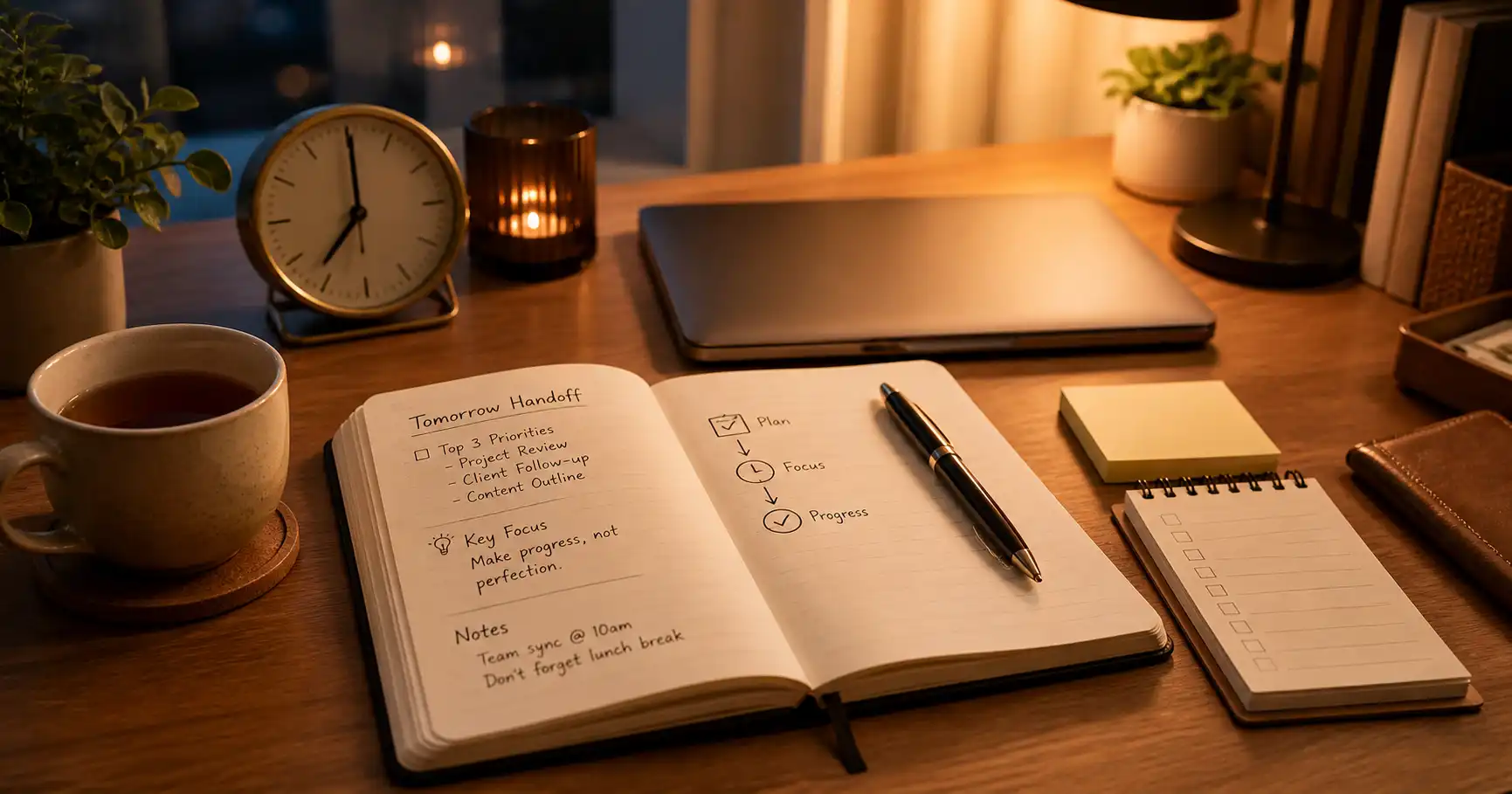
My Mornings Started Too Late Even When I Was On Time
I used to think my morning problem was that I was not starting early enough. So I tried waking up earlier, opening the laptop sooner, making coffee faster, and sitting at the desk with more seriousness. But even when I was technically on time, the real work still started late.
The first 20 or 30 minutes often disappeared into small confusion. I would open my laptop and try to remember where I stopped yesterday. Then I would check my task list. Then I would open a document. Then I would realize I needed a file. Then I would check messages "just in case." Before I knew it, the clean beginning of the day was gone.
It was not dramatic procrastination. It was quieter than that. I was not watching videos or completely avoiding work. I was just trying to find the thread again.
That is what made it frustrating. I was at the desk. I was willing to work. But I had not left myself a clear way back into the work.
Eventually I realized something simple: the morning does not only depend on the morning. A smooth morning often begins the night before, or at least at the end of the previous work session.
The Real Problem Was Not the Morning — It Was Yesterday
For a while, I blamed my morning routine. I thought maybe I needed a better planner, a better calendar setup, or some kind of strict first-hour rule. Those things helped a little, but the real problem was still there.
I was ending the previous day badly.
I would stop working when I was tired, close the laptop quickly, and tell myself, "I will remember tomorrow." Of course, tomorrow I did not remember clearly. I remembered the general project, but not the exact next step. I remembered that something was unfinished, but not what the smart restart point was.
This created a strange kind of friction. The work itself was not always hard. Restarting the work was hard.
One day I opened a document and spent almost 15 minutes rereading what I had written the previous day. Not editing, not improving, just trying to understand what past-me was trying to do. That was when I finally admitted the problem: I was leaving no instructions for future-me.
So I started using a small end-of-day note. I call it the 7-minute tomorrow handoff.
What the 7-Minute Tomorrow Handoff Is
The tomorrow handoff is a short note you write at the end of your workday or study session. It tells tomorrow exactly where to begin.
It is not a full plan for the whole day. That is important. I tried making it a full plan at first, and it became another overthinking tool. The handoff should be short enough that you actually do it when you are tired.
The note answers five questions:
What is still open?
What is the first real move tomorrow?
Where exactly should I restart?
What friction can I remove now?
How do I close today so my brain can stop carrying it?
The whole thing takes about seven minutes. Sometimes five. Sometimes ten if the day was messy. But seven minutes is the number that made it feel small enough to repeat.
The point is not to become perfectly organized. The point is to make tomorrow easier to enter.
Minute 1: Write What Is Still Open
The first minute is for writing down what is still unfinished. Not everything in your life. Only the work that is mentally open right now.
For example:
Article draft is half finished.
Need to reply to client after checking file.
Chapter notes are reviewed but not summarized.
Report has introduction but no conclusion.
Need to decide between two layout options.
This step helps because unfinished work becomes heavier when it stays vague. "I have so much to do tomorrow" creates stress. "I need to finish the conclusion and check one file" is clearer.
I used to skip this because it felt obvious. I thought, "I know what is unfinished." But the next morning, obvious things were not always obvious anymore.
Writing the open loop down gives your brain permission to stop repeating it in the background.
Minutes 2–3: Choose Tomorrow's First Real Move
The next step is choosing the first real move for tomorrow. This is where the handoff becomes useful for time management.
The first move should not be a category like "work on project" or "study more." It should be a physical action you can begin without thinking too much.
Bad first move:
Work on article.
Better first move:
Open article draft and rewrite the first paragraph of section three.
Bad first move:
Study biology.
Better first move:
Review the diagram on page 42 and write five recall questions.
Bad first move:
Catch up on email.
Better first move:
Reply to the two emails marked with a star, then close inbox.
The word "real" matters here. A real move creates progress. Opening email randomly is not always a real move. Checking Slack is not always a real move. Organizing your desk can be useful, but if you use it to avoid the task, it is not the first real move.
I try to choose a first move that takes between 10 and 25 minutes. Small enough to start. Useful enough to matter.
Minutes 4–5: Write the Restart Note
This is the part that changed my mornings the most.
A restart note is one small instruction written as if you are speaking to tomorrow's tired version of yourself.
Examples:
"Start by fixing the weak example in section two. Do not rewrite the whole article yet."
"Open the PDF to page 18. Review only the highlighted confusion marks first."
"The report structure is okay. Tomorrow just write the conclusion badly, then edit."
"Do not check messages first. The draft needs 20 minutes before anything else."
This may sound unnecessary, but it works because tomorrow-you is not always in the same mental state as today-you. At the end of the day, you still know the shape of the work. You know what is rough, what matters, what can wait, and what is not worth touching yet.
If you write that down, tomorrow does not have to rediscover it.
I like writing restart notes in plain language. Not professional. Not fancy. Sometimes mine look a little messy. That is fine. The note is not for publishing. It is for restarting.
Minute 6: Remove One Piece of Morning Friction
Minute six is practical. Remove one thing that would slow you down tomorrow.
This could mean:
Leave the right document open.
Put the notebook on the desk.
Bookmark the exact page you need.
Write the first task on a sticky note.
Close unrelated tabs.
Put the charger where it belongs.
Move the phone away from the workspace.
Place the book open to the correct chapter.
This step is small, but it matters. Many mornings get ruined by little setup problems. You cannot find the file. The laptop is low battery. The wrong tabs are open. The notebook is somewhere else. You start looking for materials, and suddenly you are not starting work anymore.
Removing one piece of friction makes the first action easier to take.
I do not try to prepare everything perfectly. That becomes another trap. Just one piece of friction is enough.
Minute 7: Close the Day Properly
The final minute is for closing the day. This sounds soft, but it is important.
I write one short line:
"Today is done. Tomorrow starts with section three."
Or:
"Enough for today. First move tomorrow: review questions 1–5."
Or sometimes, if the day was not great:
"Messy day, but not lost. Restart with the outline tomorrow."
That last kind of line helps more than I expected. Not every day ends cleanly. Sometimes I do less than I planned. Sometimes I get distracted. Sometimes a task takes longer than it should. If I end the day with guilt only, tomorrow starts heavier.
A closing line gives the day a boundary. It says: this is where I stopped, and this is where I will begin again.
For remote workers and students, this matters because work can follow you mentally even after the laptop is closed. The handoff note helps contain it.
A Real Example From a Day I Almost Left Messy
Here is a real example of how I used the handoff after a scattered workday.
I had planned to finish an article, but the day got interrupted. I answered messages, fixed a small site issue, and spent too much time adjusting images. By evening, the article was still not done.
Old me would have closed the laptop and carried a vague feeling of failure into the night.
Instead, I wrote this handoff:
Still open: article needs stronger ending and better example in middle.
First real move: open draft and write the personal example before editing anything.
Restart note: structure is fine. Do not rebuild the article. Add the example, then write final takeaway.
Remove friction: leave article draft open and close image tabs.
Close: not finished, but clear. Tomorrow starts with the example.
The next morning, I did not waste time deciding. I opened the draft and wrote the example first. That one instruction saved me from doing my usual thing, which is rereading the whole article and trying to improve everything at once.
That is when I became convinced this system was worth keeping. It did not make the work easy. It made the restart clear.
Mistakes I Made With This System
The first mistake was making the handoff too long. I tried writing detailed plans for the next day. That failed because I did not want to do it when I was tired. A handoff should be short and usable, not impressive.
The second mistake was choosing too many first moves. I would write three or four "first" tasks, which makes no sense. Tomorrow can only start with one thing. The handoff became much better when I forced myself to choose one first move.
The third mistake was leaving vague instructions. "Continue project" is almost useless. "Open project brief and write the three missing bullet points" is much better.
The fourth mistake was using the handoff to punish myself. Sometimes I would write things like, "You wasted time today, so tomorrow must be better." That did not help. It made the next day feel heavier. A good handoff should be honest, but not cruel.
I still mess this up sometimes. If I am very tired, I skip the note or write something too vague. And usually, I feel it the next morning. That has been a good reminder.
Who This Time Management Habit Helps Most
The tomorrow handoff is especially useful if you often start the day by trying to remember what you were doing yesterday.
It also helps if you work on long projects that cannot be finished in one sitting. Writing, studying, coding, design, research, business tasks, content planning, and exam preparation all benefit from a clear restart point.
It is also useful for people who feel anxious at the end of the day because unfinished work keeps floating around in their head. The handoff does not finish the work, but it gives the work a place to wait.
This habit may not help as much if your days are completely unpredictable or controlled by urgent external demands. But even then, writing one restart note can still reduce confusion when you get your next quiet block.
The point is not to control tomorrow perfectly. The point is to stop forcing tomorrow to solve yesterday's unfinished thinking.
Tomorrow Starts Better When Yesterday Leaves Instructions
Good time management is not only about planning the day ahead. It is also about ending today in a way that makes tomorrow easier.
If your mornings feel slow, messy, or unclear, do not only look at your morning routine. Look at how you ended the previous day.
Try the 7-minute tomorrow handoff:
Write what is still open.
Choose tomorrow's first real move.
Write a restart note.
Remove one piece of morning friction.
Close the day with one clear line.
This is a small habit, but it solves a very real problem. It helps you stop wasting the first part of the day trying to remember, decide, and restart from zero.
Tomorrow does not need a perfect plan. Sometimes it only needs a clear handoff from today.