The Moment I Noticed My Hand Moving Before I Decided
I was writing something on a Tuesday afternoon. A piece I'd been avoiding for a week and had finally gotten into — I knew what the next sentence was, I could feel where the paragraph was going. And then my hand moved toward my phone.
I didn't decide to pick it up. I noticed after the fact that I was already holding it, already scrolling, and I couldn't tell you what I was looking for.
That detail bothered me more than the scrolling itself. Not that I checked — I'd been doing that for years — but that my hand had made a separate decision from my brain. The movement happened before the choice. Like something in me had already given up on the paragraph before I consciously knew the paragraph was hard.
I put the phone down and tried to go back to the sentence. But the thread was gone. Whatever state I'd been in twenty seconds ago, I couldn't find it. I spent the next fifteen minutes reading the same paragraph over and over without producing anything new.
This was not a single incident. It was most of my work sessions, for a long time.
It Was Not a Discipline Problem
My explanation was the obvious one: I lacked discipline. I needed to want the work more than I wanted the distraction. I needed to be stronger.
I tried that. I would sit down, feel the pull toward the phone, and resist it through something like force of will. Sometimes it worked — for twenty minutes, maybe thirty. Then I'd be holding the phone again with no memory of picking it up.
The self-blame was exhausting. And after a while I noticed it wasn't even accurate. On the days I felt most disciplined, I still drifted. On the days I was genuinely excited about the work, I still drifted, just less. The variable wasn't my character. Something else was happening.
The thing that shifted my understanding wasn't a productivity method. It was reading about a field called captology — the study of how technology is designed to change human behavior. A behavioral scientist named BJ Fogg had spent years on this at Stanford, and the core of what he found was this: behavior happens at the intersection of motivation, ability, and a trigger. App designers use this model deliberately. They reduce the effort required to check (one tap, always accessible), increase the motivation to check (social validation, novelty, the possibility something new happened), and put triggers everywhere — sounds, red dots, badges. The pull I was feeling wasn't a character flaw. It was a response to a system that had been engineered specifically to produce that response.
I found this genuinely relieving. Not because it absolved me of responsibility, but because it changed the question from "why am I so bad at this?" to "what is this environment doing to me, and what can I actually change?" That second question has answers. The first one just produces shame.
What the Phone Takes From You Before You Even Touch It
Here's something I didn't know and wish I had known earlier.
The phone affects your cognitive performance even when you're not using it. Not as a metaphor — in a documented, measurable way.
A research team at the University of Texas ran a set of experiments where participants completed cognitive tasks under different conditions: phone on the desk face-down, phone in their pocket or bag, phone in another room entirely. The group with phones in another room significantly outperformed the groups with phones nearby — and the desk group performed worst, even though their phones were silent and face-down. The phone didn't need to ring. It didn't need to vibrate. Its presence alone was enough to reduce working memory scores and performance on tasks requiring sustained attention.
The explanation they offered: the brain knows the phone represents information it isn't processing. Maintaining the decision not to check it requires cognitive effort — even when you're succeeding at not checking it. You're paying a focus tax just to keep the phone in its place. And you pay that tax regardless of whether you check it, as long as it's within reach.
I had been putting my phone face-down on my desk and considering that focus mode. It wasn't. I was draining attention to maintain a posture of not-checking while the phone sat there being a source of unprocessed information. The only way to stop paying the tax is to remove the phone from the space entirely.
This was the first real change I made, and it felt almost too simple. I started putting the phone in the other room when I worked. The difference was immediate. Not because I stopped being tempted — I'd still occasionally walk to the other room to check it — but because the passive drain stopped.
The 23 Minutes I Was Losing Every Time I Checked
A researcher named Gloria Mark spent years measuring how people actually work in modern digital environments. She'd set up observation studies, follow knowledge workers through their days, track what they actually did versus what they said they did. One number from her research stopped me when I read it.
The average time to fully return to a task after an interruption: 23 minutes and 15 seconds.
Not 2 minutes. Not 5. Twenty-three.
The reason is something psychologist Sophie Leroy called attention residue. When you switch from one thing to another — even briefly, even voluntarily — part of your attention stays behind with what you left. It doesn't fully transfer. So when you come back to your work after checking your phone, you're not working with your full attention. You're working with whatever portion isn't still loosely attached to the notifications you just scanned, the message you half-read, the thread you opened and didn't finish.
That foggy, scattered feeling after checking the phone? That's what heavy attention residue feels like from the inside. Your attention is divided between where you are and where you just were.
I did the arithmetic and it was uncomfortable. Four phone checks in a two-hour work session doesn't mean losing four brief interruptions. It potentially means losing most of the session's productive capacity to recovery time that never fully completes before the next check arrives. The afternoons where I worked for three hours and had almost nothing to show for it — this was the mechanism. I wasn't procrastinating, exactly. I was interrupting my own recovery before it finished, over and over.
Why Trying Harder Made It Worse
Once I understood what was happening, I tried the obvious thing: resist harder. Sit with the discomfort of not checking. Push through it.
This worked, briefly and inconsistently. And there's a reason why.
Roy Baumeister's research on self-regulation found that willpower works more like a resource than a character trait. It's highest early in the day and diminishes with each use. Every time I successfully resisted reaching for the phone, I spent a small amount of that resource. An hour of resisting the pull left me with less capacity to resist than an hour of working in an environment where the pull wasn't present. I was depleting myself to maintain a position, and the depletion was invisible until it wasn't — until I found myself scrolling and couldn't explain how I got there.
The deeper problem was that I was solving the wrong problem. Wendy Wood, a behavioral scientist at USC who spent her career studying habits and environment, synthesized years of research into a finding that I keep coming back to: the people who appear most disciplined are not, on average, exercising more willpower than the rest of us. They have arranged their environments so the temptations arise less often. They don't succeed by fighting harder. They succeed by fighting less.
I'd been trying to be better. I needed to design better. Those are different projects, and only one of them works long-term.
What I Actually Changed
The biggest change was the phone in another room. I've mentioned it already but I want to be specific about what "another room" means in practice: not my pocket, not a drawer in my desk, not face-down on the desk. Physically in a different room, ideally one where getting it requires standing up and walking. This is not a metaphor for mindfulness. It is a friction intervention. It makes the reflexive check effortful enough that it becomes a decision rather than an automatic reach.
Beyond that, I went through my notification settings and turned off everything that wasn't a direct message from a person I actually knew. App badges: off. Email alerts: off. News apps: deleted. Social media: moved off the home screen, logged out. The login requirement alone eliminated most of the reflexive checking — not because I stopped wanting to check, but because the check now required an intentional act. Most of the checking I'd been doing wasn't intentional. It was automatic, habitual, a kind of ambient surveillance I'd been running in the background of everything I did. Adding friction to that behavior didn't stop it, but it surfaced it. I started noticing the impulse before I acted on it, which gave me the choice I hadn't had before.
Fogg's model again: reduce the ability required for a behavior and the behavior's frequency drops even without a change in motivation. I wasn't trying to want to check my phone less. I was making checking harder. The engineering works in your direction when you use it.
I also stopped keeping the phone charger at my desk. It charges in the kitchen now. This is a small detail that closed one more automatic loop — the "I'll just charge it while I work" that kept the phone in arm's reach for no reason that was actually about work.
The Task Has to Be Specific Enough to Start
After I'd dealt with the phone, I noticed something I hadn't fully seen before: I was still drifting. Less, but still. And I started paying attention to when it happened.
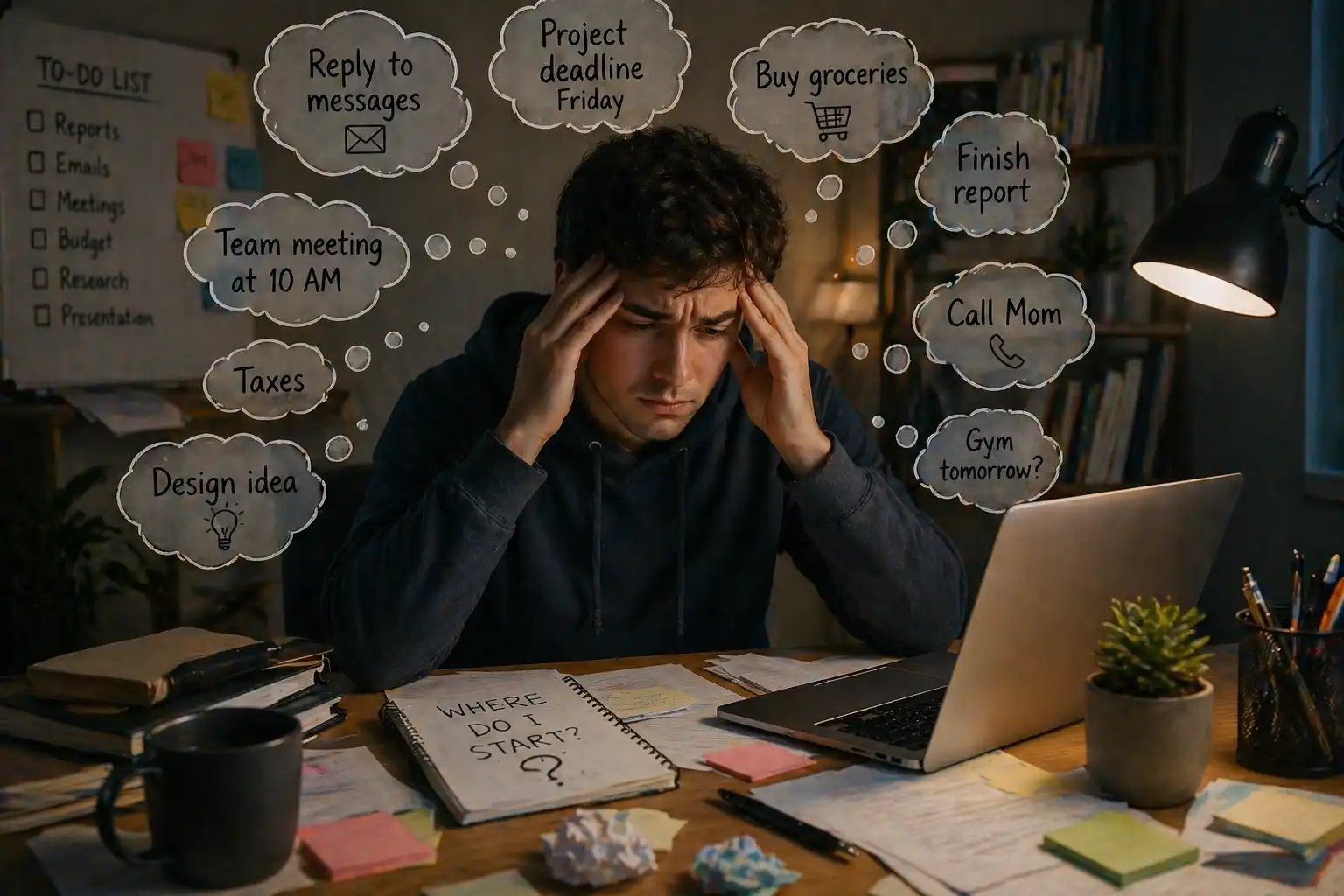
It happened most reliably at the beginning of a session, when I sat down with a vague sense of what I was supposed to do. "Work on the article." "Study for the exam." "Get some writing done." These sound like tasks. They're not — they're categories. And when the brain is given a category without a specific entry point, it generates a kind of friction, a blankness about where to begin. The phone, when it's nearby, resolves that friction by offering something immediately clear to do. The task isn't clear. The phone is. So the brain goes to the phone.
I read something by a researcher named Peter Gollwitzer on what he called implementation intentions — a specific kind of goal formation that dramatically increases follow-through compared to general intentions. The difference between "I'll study chemistry tonight" and "when I sit down at seven I'll open my chemistry notes and work through the practice problems from chapter four" isn't just specificity for its own sake. It's that the second version pre-loads the first action, so when the moment comes the brain doesn't have to decide anything. It just executes.
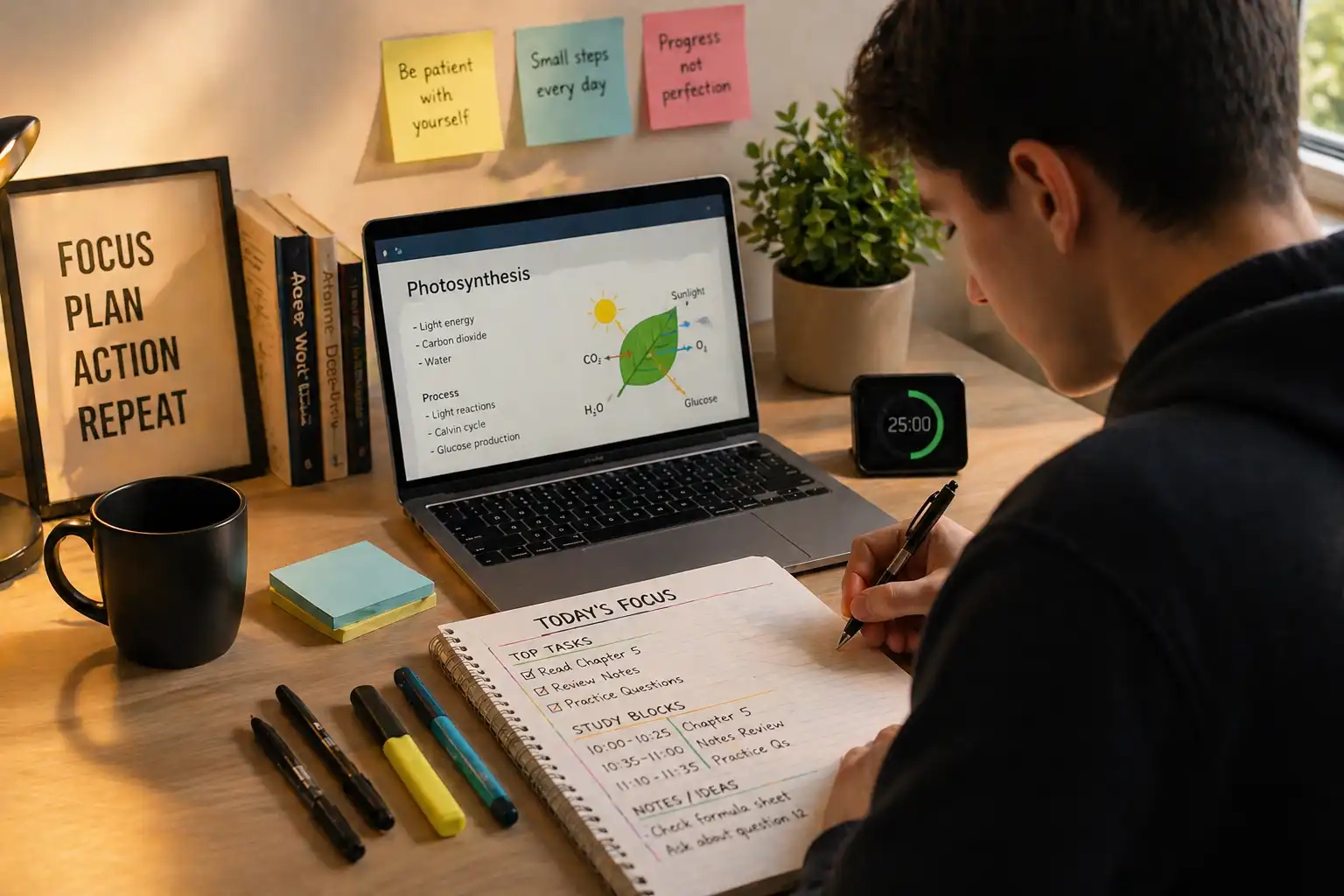
Before I start working now, I write the task in terms specific enough that I could begin within thirty seconds of reading it. Not "write the section" — "write the opening paragraph of the section on attention residue, just get it down, no editing." Not "study" — "read pages 40 to 55 and write a one-sentence summary of each subsection." The specificity gives the brain somewhere to go. And when there's somewhere clear to go, the phone becomes less necessary as an escape from not knowing what to do next.
Honest Blocks
The last thing I had to get honest about was the length of the sessions I was planning.
I used to sit down to work "for the afternoon" or "for a couple of hours." These aren't sessions — they're intentions without structure. And when a session has no visible ending, the brain treats it as indefinite, which makes it harder to fully commit to than something that ends in a specific place.
I started working in blocks of twenty-five to thirty minutes. One task, phone gone, nothing else open. When the block ends, I stop — actually stop, walk around, get water, look at something that isn't a screen — before starting the next one. This felt like less than what I should be capable of, and I had to get over that. Two completed blocks with full attention is more than four hours of fragmented work that never gets anywhere. I know this from experience, not from theory.
The thing that mattered most about the shorter blocks wasn't the length. It was the completion. When you complete a block — when you define a task, do it, and finish — something registers. Not dramatically, but it registers. And that registration makes the next block slightly easier to start, because there's evidence that you're capable of it. The long session that collapses halfway through produces the opposite: evidence that you can't hold the commitment, which makes the next one easier to abandon.
Start with a block short enough that you can genuinely finish it on a bad day. That's the right unit, not the ambitious one. Build from there.
When You Drift Anyway
I still drift sometimes. Less than I used to, and I come back faster, but it happens.
The mistake I used to make after drifting was self-criticism. I'd feel disappointed in myself, spend energy on that, and then either push through feeling bad or give up entirely. Neither of those was the right response.
I came across research by Kristin Neff at UT Austin on self-compassion, and one finding has stayed with me: self-critical responses to failure increase avoidance in future attempts. When you beat yourself up for drifting, you're not just processing disappointment — you're creating negative associations with the work itself. You're making it slightly more aversive to sit down next time. The punishment doesn't produce better behavior. It makes the next attempt harder to start.
What actually works is simpler and less dramatic. When I notice I've drifted, I just name what happened. Not to be kind to myself in some forced way, but because naming it is useful information. "I drifted because the task got vague." "I drifted because I was tired and didn't admit it." "I drifted because that section was harder than I expected and I didn't want to feel stuck." That diagnosis tells me what to fix. Punishment doesn't.
Then I fix it — rewrite the task if it was vague, take a real break if I was tired, reduce the block size if the session was unsustainable — and start again.
Drift is not the problem. It happens to everyone, at every level of focus. The problem is staying away after the drift, treating the slip as evidence that the session is over. It isn't. The session is over when you stop returning. Keep returning, without drama, and the focus improves over time in a way that trying harder never produced.