
Why What You Do Before Work Shapes How Easily You Can Focus
Most people treat focus as a switch. They finish scrolling, sit at the desk, open a document, and expect their attention to arrive fully formed. But attention does not switch. It transitions. And the state it transitions from matters enormously.
When the hour before studying is full of social feeds, short videos, and rapid notification checking, your brain arrives at the desk in a particular state: expecting fast input, expecting novelty, expecting the next thing quickly. That expectation does not disappear because you opened a textbook. It competes with the slow, effortful processing that reading and thinking actually require.
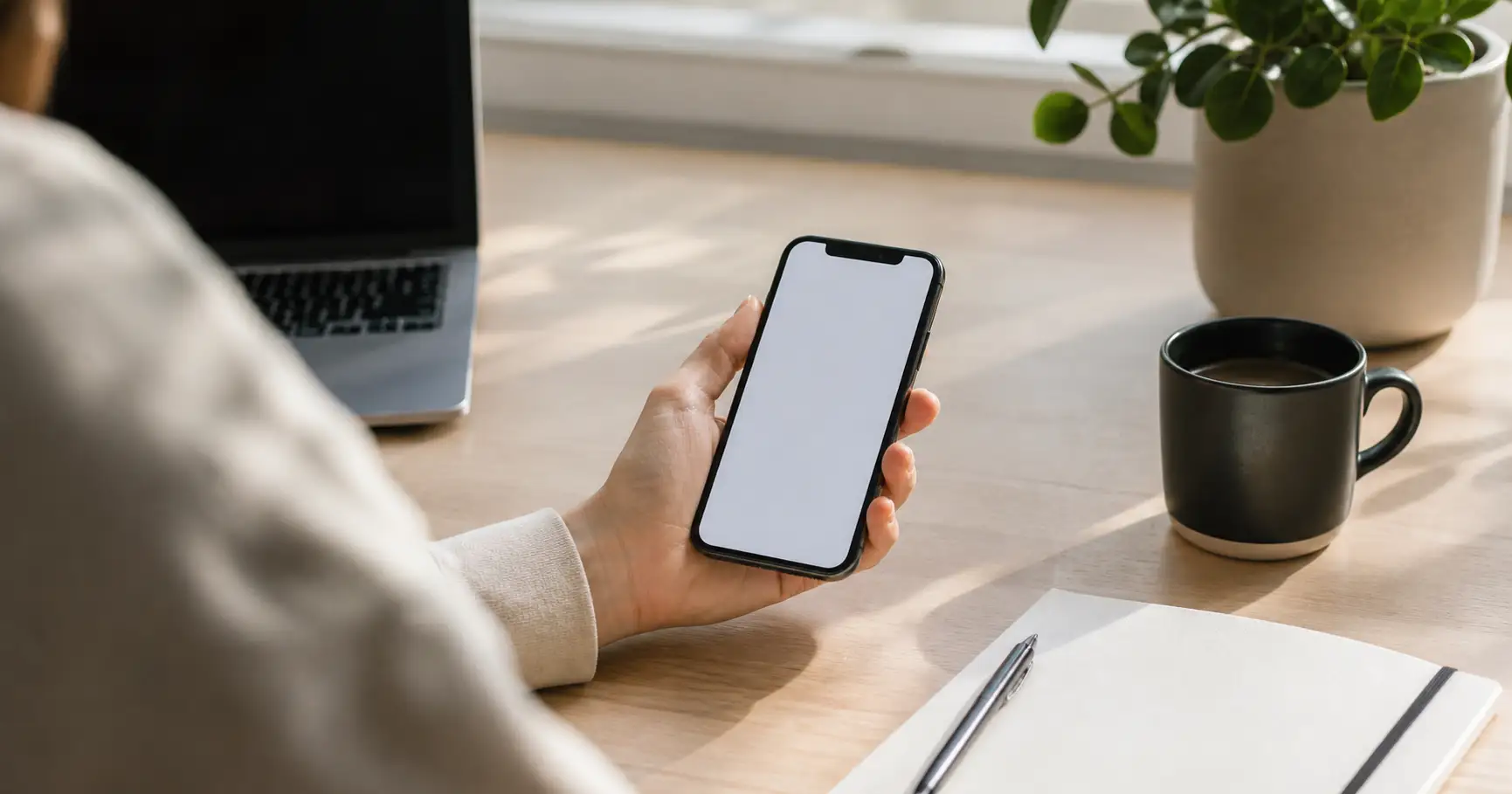
The dumb phone hour is a way to change what state you enter work from. Not by eliminating the phone — by changing what the phone does during that hour.
Attention Residue: The Invisible Cost of a Stimulating Pre-Work Hour
Organizational psychologist Sophie Leroy identified a phenomenon called attention residue: when you switch from one task to another, part of your cognitive attention stays behind on what you just left. The more incomplete or engaging the previous activity, the stronger the residue.
Social media feeds are specifically designed to be never-ending. There is no natural stopping point, no moment of completion. That makes the residue worse. When you stop scrolling, you have not finished anything. You have only interrupted an infinite stream. Your brain has a harder time releasing it than it would if you had finished a chapter, completed a puzzle, or reached any kind of natural endpoint.
This is not willpower failure. It is the predictable consequence of using a product engineered to stay open. The dumb phone hour short-circuits it by replacing infinite feeds with tools that have clear endpoints — a timer that finishes, a calendar entry you checked, a note you wrote. The brain gets closure, and closure reduces residue.
The Tools vs. Feeds Audit: What Your Phone Is Actually Doing to You
Before running the dumb phone hour, it helps to know which apps are actually the problem. Most people underestimate this. They think they only use Instagram casually, but they open it fourteen times a day for thirty seconds each. Those thirty-second hits add up — and each one resets the residue timer.
Do this audit once. Open your phone's screen time report (Screen Time on iOS, Digital Wellbeing on Android). Look at the top apps by opens per day, not just total minutes. An app you open twenty times a day is more disruptive than one you use for thirty focused minutes.
Feeds: Instagram, TikTok, Twitter/X, YouTube homepage or Shorts, Reddit, news apps, email inbox browsed for interest rather than action, Snapchat streaks. These are the apps that have no natural stopping point. Every time you open them, you begin something unfinished.
Tools: Timer, calendar, maps, notes, calculator, messaging to respond to a specific question, music playing a preset playlist. These have a clear beginning and end. You use them and then you are done.
Some apps sit in the middle. Email is a tool when you are responding to one specific message. Email is a feed when you are browsing it for something interesting. YouTube is a tool when you play one specific video you already decided to watch. YouTube is a feed when you open the homepage. The distinction is not the app — it is the mode of use.
How to Run the Hour: Three Concrete Rules
The dumb phone hour does not require an app or a special setup. It requires three rules held consistently for one hour before you start working.
Rule one: move feed apps off the main screen. You do not need to delete anything. Move every feed-based app into a folder on the second or third page of your phone. Name the folder something neutral like "Later." Your thumb cannot open what it does not automatically see. The one-second friction of having to navigate to the folder is genuinely enough to break most reflexive opens — because reflexive opens are not intentional. They are habit loops triggered by visibility.
Rule two: set a ten-word list of what is allowed. Write it. "Timer, calendar, notes, maps, specific playlist, calls." That is your phone for this hour. When you feel the pull to check something outside the list, the list is the answer. This is not a rule you negotiate in the moment — the moment is the worst time to make that decision.
Rule three: phone face-down or in another room when you sit at the desk. Even a phone placed screen-up with notifications silenced captures a small amount of attention — the visual presence of it registers. Face-down or out of sight removes that. The first rule covers the pre-work hour; the third rule covers the work session itself. Together they create a clean separation.
How to Make It Automatic by Stacking It Into What You Already Do
Habits that require a new decision to start rarely stick. Habits that attach to something you already do require no decision — the trigger is already built in.
Choose one thing you already do reliably every day before your study or work session. Waking up. Drinking coffee. Showering. Eating breakfast. Walking to the library. That existing behavior becomes the trigger.
The formula is: "After [existing behavior], I will switch my phone to dumb mode until my work session begins." If you always drink coffee before studying, the coffee is now the trigger. If you always take a shower before sitting down to work, the shower is the trigger. You do not decide each day. The trigger decides for you.
The second part of stacking is the endpoint. "Until my work session begins" gives you an off-ramp. The hour does not feel like deprivation when there is a clear moment it ends. You are not restricting yourself forever — you are creating a protected window. That framing is easier to sustain than "I should use my phone less."
What the First Few Days Actually Feel Like — And What That Means
Most people find the first two to three days uncomfortable. The urge to check something arrives frequently — sometimes every few minutes. This is worth understanding, because if you mistake discomfort for failure, you will quit a habit that was about to work.
The urge is not a sign that something is wrong. It is a sign that the habit you are replacing was real. Feeds are engineered to create checking behavior through variable reward — you check because sometimes there is something interesting, and you cannot predict when. The urge is that pattern surfacing. It typically peaks on day two or three and noticeably fades by day five to seven.
What most people notice around day four is not boredom — it is a different quality of morning. The drag getting into the first task feels lighter. They are not fighting through residue. The work is still hard, but the entrance into it is easier. That shift is the signal that the hour is doing what it is supposed to do.
If boredom appears during the hour, that is also worth noting. Boredom is not emptiness. It is what the brain experiences when it stops receiving fast external input. It is the space before your own thoughts arrive. For many people, that is the most uncomfortable part — but it is also where the pre-work mental clearing happens.
When the Dumb Phone Hour Does Not Help (and What to Try Instead)
The dumb phone hour solves one specific problem: attention fragmentation caused by high-stimulation pre-work phone use. It does not solve every focus problem.
If you run a clean dumb phone hour and still find it hard to start work, the problem is likely not stimulation — it is something else. Three common ones:
Task vagueness. If you do not know exactly what you will do when you sit down, no amount of phone management will help. You need a specific first action — not "study chemistry" but "re-read pages 34 to 41 and answer the end-of-chapter questions." The dumb phone hour lowers the cost of starting; it does not tell you what to start on.
Exhaustion. If you are genuinely tired, the issue is recovery, not stimulation management. A dumb phone hour won't create energy that isn't there. Rest first, then the hour before the next session.
One hour feels impossible. Start with twenty minutes. The mechanism still works at a shorter duration — you are still reducing residue before work. Build from there. A twenty-minute version you actually run beats a sixty-minute version you abandon after two days.
The Hour Before Work Is Part of the Work
The boundary between preparation and work is not as sharp as it looks. What you do in the hour before a study session shapes how that session begins, how long it takes to reach real focus, and how much of your attention is actually available when you need it.
The dumb phone hour is not about self-discipline or digital purity. It is about entering the work in the right state. Do the tools-vs-feeds audit once, move the feed apps off the main screen, set your allowed list, and attach the habit to something you already do every day.