The Day I Caught Myself Unlocking the Phone Without a Reason
I was standing in line at a coffee shop. There was nothing I needed to look at. I had checked messages a few minutes earlier. The phone had not buzzed. I had not thought of anything I wanted to search. And I noticed, partway through the action, that I was unlocking it anyway — that I had pulled it out, swiped the screen, and was now looking at the home screen for a reason I could not name.
I locked it. I put it back. Then I unlocked it again, almost involuntarily, about a minute later. Same situation. Same nothing-in-particular. The unlock had happened before I made any decision to do it.
What I noticed about that second unlock was specific enough to be uncomfortable. The destination was not an app. It was not a message or a video or any particular piece of content. The destination was the home screen itself. The grid of icons. The arrangement of colored squares with their red badges. I was unlocking the phone to look at the home screen, then locking it again, with nothing in between. That had been happening, by my rough count, dozens of times a day — far more than the times I picked up the phone to actually do something with it.
This was not a discovery about a bad day. It was a discovery about most days. I had been telling myself I checked the phone because I needed to. The actual data of my behavior said something different. I was opening the phone because the home screen, in some way I had not bothered to examine, was performing a function for me. I just had no idea what function.
It Was Not a Discipline Problem
My first interpretation was that I needed to be more present. More disciplined. Less restless. I tried various versions of this — leaving the phone at home for short errands, doing phone-free Sundays, setting screen-time limits, trying to make myself want to check less.
All of it worked briefly and then degraded. The limits got ignored. The phone-free Sunday made me anxious by lunch and reaching for the phone harder by evening. The "want to check less" framing produced a fight with my own attention that I lost steadily over the course of any given week.
Eventually, behavioral scientist Wendy Wood's research gave me a different frame. Wood, who has spent decades studying how habits actually form and change, has documented a finding that contradicts most self-help advice on the subject. The people who appear most disciplined are not, on average, exerting more willpower than the rest of us. They have arranged their environments such that the impulses arise less often in the first place. The fight against impulses is the wrong fight. Redesigning the environment that produces them is the actual move.
This shifted the question for me from "how do I check my phone less" to "what about my phone is making me check it without a reason." That second question turned out to have a much more specific answer than I expected.
The Home Screen Is Not a Display — It Is a Cue
The frame that finally explained what was happening came from research on habit formation that Charles Duhigg, in The Power of Habit, traced back to neuroscientist Ann Graybiel's work at MIT. Graybiel and her colleagues, studying the basal ganglia, established a structural model of how repeated behaviors get encoded in the brain: cue, routine, reward. The cue is the trigger. The routine is the behavior. The reward is what reinforces it. Once a loop is established, the cue can fire the routine automatically, often below the threshold of conscious decision.
Applied to my phone use, the loop was straightforward. The routine was opening an app and scrolling. The reward was variable — sometimes interesting, sometimes nothing. And the cue, the thing that triggered the loop without my involvement, was visual: the home screen revealed at the moment of unlock. The grid of icons. The red badges. The small visual stimuli that the brain's attention system processes preattentively, before any conscious decision to look has occurred.
This explained the part of my behavior I could not otherwise account for. I had not been deciding to check apps. By the time I was conscious of a decision, the routine had already started. The unlock had revealed the cue, the cue had triggered the routine, and I was on Instagram before any deliberation had taken place. This was not a failure of willpower. It was a habit loop firing as habit loops are designed to fire — automatically, in response to the cue that had been positioned to fire it.
What made this design especially effective was not accidental. The colors of social media app icons are chosen for visual salience. The badge system displays unresolved-information signals that the brain reads as open loops requiring attention. The arrangement of apps on the default home screen is not a neutral display of available tools. It is a structured cue environment, optimized to maximize engagement. The system was doing exactly what it was built to do.
Why You Keep Checking When Nothing Important Is There
The second mechanism I had not understood was something I had encountered in other contexts but not connected to phones: variable ratio reinforcement.
B.F. Skinner's research, established in the mid-twentieth century and replicated across countless studies since, found that behaviors rewarded on a variable schedule — where the reward arrives unpredictably — are dramatically more persistent than behaviors rewarded on a fixed schedule. A pigeon pecking a lever that delivers food every time learns to stop pecking when the food stops. A pigeon pecking a lever that might deliver food keeps pecking long after the rewards have ended. The unpredictability is what binds the behavior.
The phone is a variable-reward machine. Most unlocks produce nothing. No important message. No interesting update. No genuinely needed task. But occasionally — unpredictably — an unlock contains something that matters. That occasional, unpredictable reward is what makes the checking behavior nearly impossible to extinguish through willpower alone. The brain is responding to the schedule, not to the average return.
Adam Alter, in Irresistible, traces how modern apps are deliberately engineered around this principle. The home screen is the entry point. The apps are the slot machines. The badges are the lights that say "pull this lever — something might be here." This is not an accusation of bad faith; it is the product of behavioral design optimized for engagement metrics, which is what the design is rewarded for producing. The point is not to assign blame. The point is to recognize what the system is doing so you can stop interpreting your own behavior as a problem of character. The behavior is the predictable output of the design. The design can be changed.
The Cost of Carrying a Lobby in Your Pocket
There is a separate cost the home screen imposes even when you are not unlocking it.
A research team led by Adrian Ward at the University of Texas conducted a set of experiments in which participants completed cognitively demanding tasks under different conditions: phone on the desk face-down, phone in their pocket or bag, phone in another room entirely. The group with phones in another room significantly outperformed both other groups. The desk group performed worst. The phone did not need to ring, vibrate, or even be visible — its presence alone reduced working memory performance and the capacity for sustained attention.
Ward's explanation: the brain knows the phone represents an information environment it is not currently processing. Maintaining the active decision not to check it requires cognitive effort. You are paying a focus tax just to keep the phone in its place. And the tax compounds when the home screen is full of badges, each of which is an unresolved notification the brain is partially tracking, even when you have decided not to look.
This was the part that connected the home screen specifically to broader attention quality. A phone with a default home screen full of high-engagement apps is not just a tool you sometimes use. It is a small portable lobby of unfinished business that you carry into every task you do. The lobby does not go quiet when you stop looking at it. It runs in the background, consuming a slice of cognitive capacity you would otherwise have available for the work in front of you.
What a Blank Home Screen Actually Is
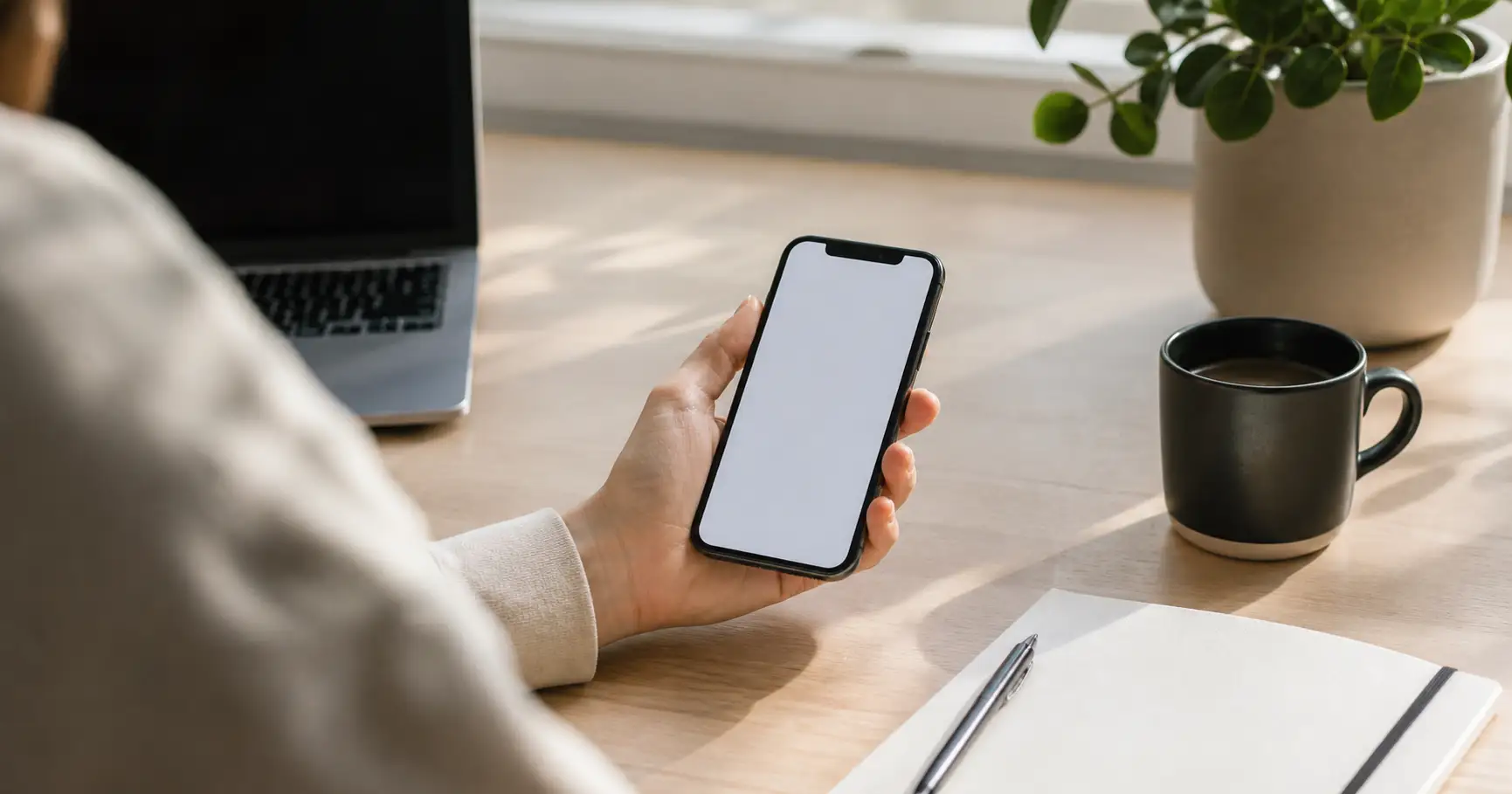
The blank home screen is not a minimalist aesthetic choice. It is a removal of the cue.
The mechanics, kept practical: the first screen visible when you unlock the phone should contain no apps you would open without a specific reason — no social media, no email, no news, no video apps. Ideally, no apps at all. A clock and a wallpaper. Possibly a search field.
The point of the empty first screen is not to look minimal. It is to ensure that unlocking the phone, in the absence of a specific reason, produces nothing. There is nothing to drift into. There is no badge to resolve. There is no icon whose color and position have been optimized to draw attention. The visual environment after unlock provides no input that could fire an automatic routine.
What this does, in habit-loop terms: it removes the cue while leaving the rest of the system intact. The routine — opening apps — is still available when you have a reason. The reward, whatever it is, is still possible. But the unprompted trigger that previously started the loop without your involvement is no longer there. The brain has nothing to respond to. The unlock without intent produces only an empty screen, and an empty screen does not start a routine.
This aligns with what Wendy Wood's research consistently finds about successful habit change: the most reliable interventions are not those that suppress an existing behavior but those that remove the cue that produces it. The blank home screen is that intervention for phones. It works not by making checking harder once started, but by making the unprompted start less likely to occur in the first place.
The Three Layers That Make It Hold
An empty first screen alone is not enough. If the second screen still contains the feed apps in their familiar grid, you will learn within a week to swipe past the blank screen reflexively — the cue has just moved one swipe deeper. The intervention needs layers.
Layer one: an empty first screen. Wallpaper, clock, no app icons. When you unlock, the visual field is intentionally uneventful. This is what removes the immediate cue at the moment of unlock.
Layer two: a single screen of tool apps only. One swipe over: a small grid of pure tools — phone, messages from specific people, calendar, camera, notes, maps. Nothing with an algorithmically generated feed. Nothing that requires you to scroll to see what is there. These are apps that have a beginning and an end. You use them, you stop using them, you put the phone down. This screen contains things you might genuinely need; it does not contain things designed to consume your attention.
Layer three: feed apps require search. Instagram, Twitter/X, TikTok, YouTube, news apps, email when used for browsing rather than direct response — these are removed from the home screens entirely. They live only inside the app library or as a search result. To open Instagram, you have to swipe down, type "ins," and tap. That extra step is small, but it is decisive. It converts a reflex into a decision.
The structure exploits a finding from BJ Fogg's work on behavioral design at Stanford: small increases in friction produce disproportionately large reductions in unwanted behavior, while small reductions in friction produce disproportionately large increases in desired behavior. The reflexive checking pattern depends on the path of least resistance being a feed. When the path of least resistance is empty space, and reaching the feed requires a deliberate sequence of actions, most reflexive checks dissolve before they begin. Not all of them. Most of them.
What the First Two Weeks Actually Feel Like
The first three or four days are uncomfortable. The phantom reach is strong. I would unlock the phone, see nothing, and feel a brief disorientation — a "what was I going to do?" sensation that I had not realized was usually answered for me by whatever app happened to catch my eye. Now there was no answer. I had to either find a reason or lock the phone again.
By the end of the first week, the phantom reach started weakening. The unlocking-without-a-reason behavior was, in habit-loop language, undergoing extinction — the brain was learning that the cue no longer reliably produced a reward, so the routine of unlocking became less automatic. I noticed myself reaching for the phone less often. Not because I was resisting more, but because the reflex had less to anchor to.
By the end of the second week, the new shape of the phone settled into something else: a tool I used when I had a reason, and ignored when I did not. The default behavior had inverted. Before, the default had been to open the phone; now the default was to leave it alone. The friction of having to type a search term to reach feeds was small but apparently sufficient. Most of the previous checking, I came to realize, had not been driven by genuine wanting. It had been driven by the cue.
The honest qualifier: the phantom reaches never fully go away, especially on tired or anxious days. The setup does not make me a different person. It just changes which behaviors are the default and which ones require an act of intention. That asymmetry is what does the work.
What Is Left When the Cue Is Gone
The thing I expected the blank home screen to do, when I set it up, was reduce my screen time in some general arithmetic sense — fewer minutes per day, fewer unlocks. Some of that has happened, modestly. But the more interesting effect is different.
The phone, with the cue removed, became smaller. Not physically, and not in terms of how often I use it for things I actually want to do — calls, navigation, taking notes, looking up specific information, listening to music with intent. Those happen as often as before. What got smaller was the phone's presence in moments where I did not need it. The waiting-in-line moments. The kettle-boiling moments. The few-seconds-between-tasks moments. The phone stopped being the default thing to do during those gaps.
What filled the gaps was not always something better. Sometimes it was just empty space — the standing-in-line moment now contained standing in line, with whatever thoughts arrived in it. That used to feel uncomfortable. It mostly does not anymore. The blank-home-screen intervention turned out to be less about the phone than about restoring a tolerance for unstructured attention that the home screen had been training out of me, one unlock at a time.
The phone configured this way is a tool I use. The phone configured the other way was an environment I lived inside. Those are different things, and which one you have is not determined by how disciplined you are. It is determined by what your first screen shows you the moment you unlock it.