
Why Open-Ended Study Sessions Fail Before They Start
Most students have tried some version of this: sit down with the intention to study for the evening, open the books, and immediately feel the weight of the whole session before a single page has been read. Not laziness. Something more specific: the sensation of committing to an undefined amount of effort with no visible ending point.
This experience has a psychological basis. Goal-setting research consistently shows that vague goals produce less effort and less persistence than specific, bounded ones — not because vague goals feel less important, but because the brain cannot generate an approach to something without a clear structure. "Study for tonight" has no structure. It has no start point clear enough to begin, no end point close enough to make progress feel measurable, and no way to tell the difference between making progress and stalling.
The result is familiar: reorganizing the desk, checking the phone, making tea, telling yourself you will really start after one more thing. These are not failures of discipline. They are the predictable response to a goal that gives the brain nothing concrete to engage with. The block-based method is a structural answer to a structural problem — not a motivational one.
The Timer Is Not the Point — This Is What Actually Matters
The visible feature of time-blocked study methods is the timer. This creates a common misunderstanding: students set a twenty-five-minute timer, sit down without a clear task, and wonder why the block feels like a countdown to nothing.
The timer is a mechanism, not the solution. Its only job is to create a visible boundary — a clear ending point — so the brain can commit to a finite effort rather than an open-ended one. The timer works because it tells your brain: "This is not forever. This ends in twenty-five minutes." That makes starting easier in the same way that knowing a difficult conversation is limited to ten minutes makes it easier to begin.
But the timer cannot create clarity about what happens inside the block. That clarity comes from the task definition, not the timer. A vague task run under a twenty-five-minute timer is still a vague task. It will produce vague, scattered work with a loud finish. The timer without the task definition is almost useless.
This is the piece that most descriptions of time-blocking leave out: the block structure only works when the task definition is specific enough that you could open the right material and start working within thirty seconds of reading it. That level of specificity is the real skill, and it is learnable.
How This Method Differs From Standard Pomodoro Advice
The Pomodoro Technique, developed by Francesco Cirillo in the 1980s, popularized the idea of working in twenty-five-minute intervals separated by short breaks. It is a well-established method with genuine research support, and the block approach described here shares its basic structure. Acknowledging that is straightforward.
Where this method diverges is in its emphasis on what happens before the timer starts — specifically, the task definition protocol — and in its treatment of breaks, stuck points, and low-energy adaptations. Standard Pomodoro advice tends to treat the interval as the primary variable: just set the timer and begin. What this approach argues, based on consistent failure with that instruction, is that the interval is almost irrelevant compared to the quality of the task definition.
Students who try twenty-five-minute blocks and report they do not work are almost universally using tasks that are too broad. "Study chemistry" does not become a useful study block just because it runs for twenty-five minutes. "Write out the steps of glycolysis from memory and check against the textbook" does. The distinction is not subtle. It changes the entire experience of the block from drifting to directed work.
The number twenty-five is also not sacred. Some subjects — dense reading, complex mathematics, programming problems — may need thirty-five or forty-five minutes to reach any productive depth. Some students find that twenty minutes is already the right limit for high-concentration work. Test the range. What the research on cognitive fatigue suggests is that somewhere between twenty and fifty minutes is where most people can sustain genuine attention on a difficult task without significant degradation. The default of twenty-five is a starting point, not a rule.
The Task Definition Problem: Why Vague Tasks Ruin Good Timers
The single most important skill in this method is writing a task specific enough to begin immediately. This is harder than it sounds because the language of study — "review," "study," "go over," "work on" — feels specific while actually pointing at nothing.
A task is specific enough when it passes this test: if you read the task description, could you open the correct material and start working within thirty seconds, without deciding anything else? If the answer is no, the task needs to be narrowed.
The categories of vagueness that most commonly kill study blocks:
Subject-level tasks. "Study biology." This is a subject, not a task. It does not tell you which part of biology, what kind of engagement is expected (reading, recall, problem-solving), or what finished looks like. Any twenty-five minutes spent on "studying biology" will be unfocused because there is no target.
Outcome-level tasks without actions. "Understand chapter three." Understanding is the goal, not the task. What specific activity produces understanding? Reading it? Summarizing it? Answering questions about it? The task needs to be the activity, not the hoped-for outcome.
Multi-part tasks. "Review notes, do practice problems, and check answers." This is at least three tasks, possibly four depending on how many practice problems. A block can only hold one task at full attention. If the task has multiple parts, pick the first part as the block's task and treat the others as subsequent blocks.
What a Properly Defined Block Looks Like Across Different Subjects
Here are specific examples of the difference between vague and defined tasks across common subjects. The defined version is what gets written before the timer starts.
Mathematics. Vague: "Do math homework." Defined: "Solve problems 12 through 18 from the chapter 7 assignment, showing all work and checking each answer against the back of the book."
Essay writing. Vague: "Work on essay." Defined: "Write the first rough draft of the body paragraph on economic causes — do not edit while writing, just get the argument on the page." The no-editing instruction is important: it prevents the block from becoming revision rather than drafting.
Reading and reviewing. Vague: "Read chapter four." Defined: "Read pages 67 to 84 and write a two-sentence summary of each section in my own words — no highlighting, no rereading, just note and move on." The summary constraint creates active processing. Reading without a response task produces recognition, not recall.
Vocabulary and language. Vague: "Study vocabulary." Defined: "Work through the 20-word set using the read-cover-recall-check cycle: read the word and definition, cover the definition, recall it, check. Mark any that take more than two attempts." The cycle is the task. The marked words become the next block's focus.
Science or history recall. Vague: "Review for the test." Defined: "On a blank page, write everything I can remember about the causes of World War One without looking at notes. After eight minutes, open notes and add anything I missed with a different color." Recall before review is significantly more effective than review alone at producing durable memory.
The Two-Minute Pre-Block Setup That Prevents the Most Common Interruptions
Preparation is not part of the block. It is a separate, brief activity that happens before the timer starts. Its purpose is to remove the predictable friction points that will interrupt the block if they are not resolved in advance.
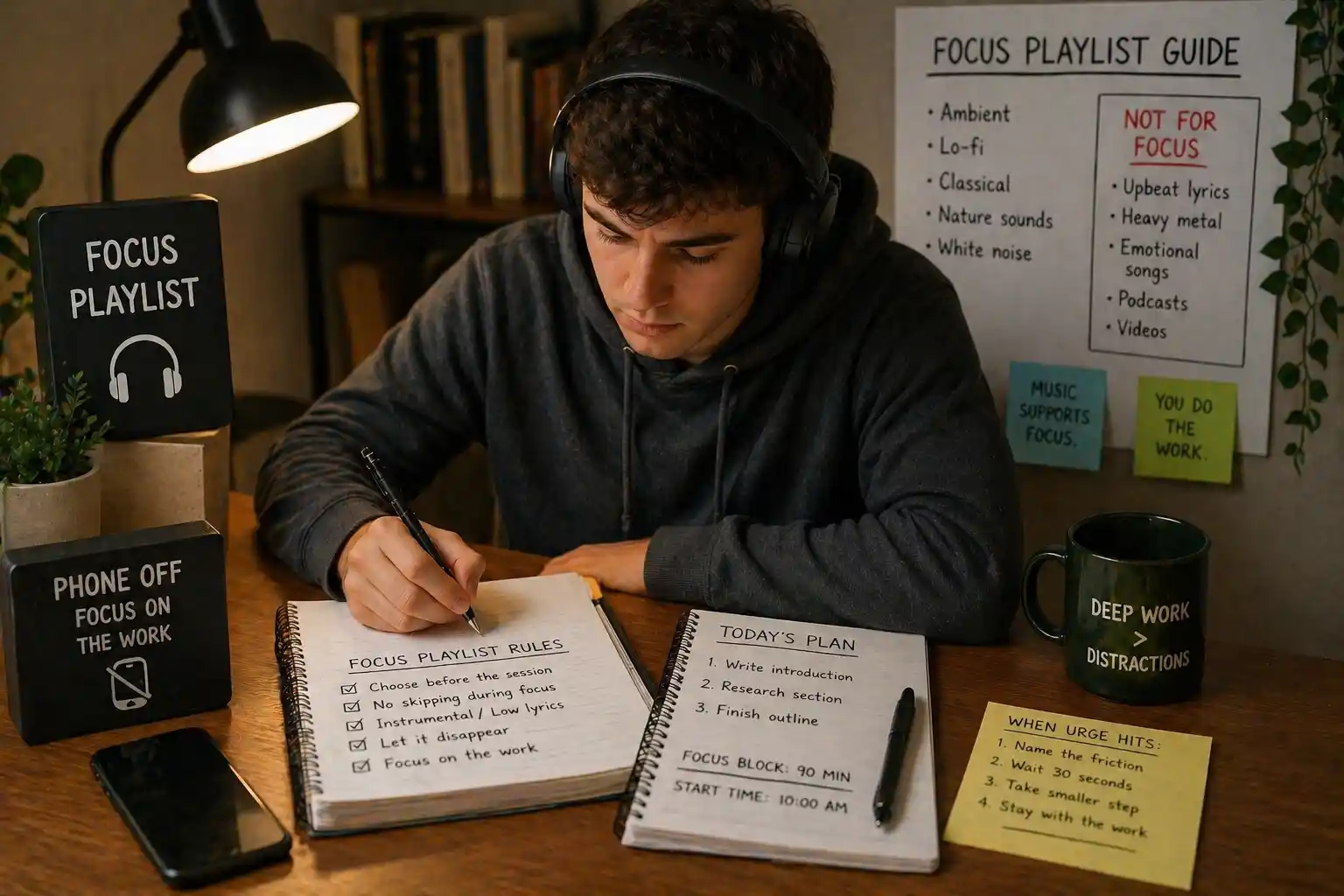
The pre-block setup takes two minutes. During those two minutes: put the phone in another room or a drawer, close every browser tab that is not needed for this specific block, get water or whatever you will need to drink, open the exact material the task requires (the right page, the right document, the right problem set), and write the task at the top of the page.
That last step — writing the task — is not redundant. You have already defined the task before sitting down. Writing it again at the top of the page creates a visual anchor. It keeps the task visible during the block, which matters most when the block becomes difficult and the brain starts looking for an exit.
The setup rule: once the timer starts, everything needed should already be present. If you discover mid-block that you need a calculator, a textbook, or a specific document, the block is already degraded. Anticipating these needs before the block begins is not perfectionism — it is practical friction removal.
Sequencing Multiple Blocks: How to Arrange a Full Study Session
One block is rarely enough for a full evening's study. Most students need two to four blocks across one or two subjects. The sequencing of those blocks matters more than most people expect.
The principle is simple: place the most cognitively demanding task first. Attention and executive function are highest at the beginning of a session. If the first block goes to the easiest subject or the most comfortable task, the most demanding work is always saved for when the brain is least equipped to handle it. This is backwards from how most students intuitively sequence their studying — starting with what is easy to build confidence — but it is consistently worse by outcome.
Within a multi-block session covering a single difficult subject, move from challenging to consolidating. A mathematics session might begin with new problem types requiring full attention, then move to reviewing older problem types with less pressure, then end with a recall exercise writing formulas from memory. The session becomes progressively less cognitively demanding as energy naturally depletes. Each block has a task appropriate to the remaining capacity, rather than asking the same quality of effort throughout.
Between subjects, consider the cognitive mode required. A writing block followed by a math block works well because the modes are different enough to feel like a rest from each other. A reading block followed by an essay block both require sustained verbal processing and may feel more tiring in sequence than alternating with something more mechanical.
Breaks That Actually Restore Attention (and Ones That Do Not)
The break between blocks is not optional and not cosmetic. It is a functional part of the system. Skipping it or substituting it with something that mimics rest without providing it is one of the most common reasons block-based studying feels exhausting rather than sustainable.
What restores attention in five minutes: standing up and moving, looking out a window or at something distant, drinking water or eating something small, having a brief non-work conversation, breathing. The common feature is that these activities require minimal cognitive effort and involve some form of physical change.
What does not restore attention in five minutes: checking a phone, opening social media, reading news, watching a video clip, scrolling anything. These activities feel like rest because they require no academic effort, but they actively engage the attention system — specifically its novelty-seeking function — in a way that makes re-engagement with demanding work harder, not easier. Sophie Leroy's research on attention residue shows that switching from an unfinished engaging activity to a demanding task produces measurable interference. A five-minute social media break between study blocks creates exactly this condition.
Five minutes of genuine physical rest is meaningfully more restorative than ten minutes of scrolling. This is not intuitive, because scrolling feels passive and therefore restful. But rest for the attention system looks different from physical rest. The attention system rests when it is not asked to process novel input rapidly — not when it has traded one screen for another.
After two or three consecutive blocks, a longer break of fifteen to twenty minutes is appropriate and expected. This is not a sign that the system is failing. It is the point at which sustained cognitive effort has genuinely depleted the resources needed for the next block, and a longer recovery period is required before the next one can be productive.
What to Do When You Get Stuck Mid-Block
Blocks get stuck. The task felt clear at the start, but somewhere in the middle, a problem that cannot be solved appears, a paragraph that cannot be continued arrives, or a concept that refuses to make sense stops progress.
The default response for most students is to quietly abandon the block's actual task and shift to something else — reorganizing notes, rereading an earlier section, checking a message. This feels like continuing to study. It is not. It is avoidance with educational aesthetics. It also teaches the brain that difficulty is a sufficient reason to switch, which gradually makes every subsequent block more fragile.
The productive response to mid-block stalling has three stages. First, name the obstacle in one specific sentence. Not "I'm confused about this chapter" but "I do not understand why the equilibrium constant expression uses concentration and not moles" or "I cannot figure out where to put the transition sentence between these two arguments." The specificity is essential: a named obstacle can be worked with. A vague feeling of confusion cannot.
Second, make the smallest possible genuine progress. If the full problem cannot be solved, solve the first step. If the paragraph cannot be written, write one honest but rough sentence. If the concept cannot be understood, write what is understood so far — even one correct statement about the material. Movement, however small, prevents the block from becoming a stall.
Third, if the obstacle genuinely cannot be resolved within the block because it requires help from a teacher, a resource that is not available, or a concept that needs more background than the block can provide, write it in a confusion list and move to the next part of the task. A confusion list makes stuck points into a follow-up agenda rather than a study-stopper. The block continues around the obstacle rather than stopping at it.
Adjusting the Method When Energy Is Low
The twenty-five-minute block assumes a level of cognitive capacity that is not always available. On genuinely low-energy days — after a long school day, poor sleep, high emotional stress, or extended time already studying — forcing a full block may produce effort without output, and the frustration of that experience may make the next session harder to start.
The adjustment is not to skip the session. It is to lower the block size to match the available capacity. A ten-minute block with one well-defined maintenance task — reviewing flashcards, rewriting one confusing definition from memory, reading one section summary — is enough to maintain the habit and keep the material warm without demanding what is not available.
The rule on low-energy days: the block is always optional to extend but never optional to start. Begin the ten-minute version. After ten minutes, assess honestly. If capacity has improved — which happens more often than expected, because starting usually makes the state better — extend into a full block. If it has not, stop without guilt and mark the session as completed. The maintenance version still counts. The habit is unbroken.
What Changes After Using This Consistently for Two Weeks
The most immediately noticeable change is at the beginning of sessions. When the task has been defined in advance, the pre-block setup takes two minutes, and the timer structure is familiar, the gap between sitting down and actually working shrinks to almost nothing. The negotiation phase — the internal debate about where to start, whether to start, whether you are ready — disappears. The session begins because the decision was already made.
The second change is in how difficulty during sessions feels. After two weeks of staying with stuck points rather than switching to easier tasks, the experience of mid-block difficulty becomes less alarming. The brain has accumulated evidence that difficulty does not necessarily mean the task is impossible — it often means the task requires another two minutes of effort. That evidence makes the impulse to escape weaker.
The third change is in how you estimate study tasks. After defining tasks specifically for two weeks, you develop an accurate sense of how much can fit in twenty-five minutes. This makes planning more realistic and reduces both the over-planning that produces guilt and the under-planning that produces wasted time. The estimate improves because it is being tested against reality every day, rather than made optimistically in the abstract.
None of this makes studying easy. It makes studying structured enough that your effort goes into the material rather than into managing the study session itself. That shift is the value of the method — not speed, not inspiration, but the reliable conversion of available time into actual progress.