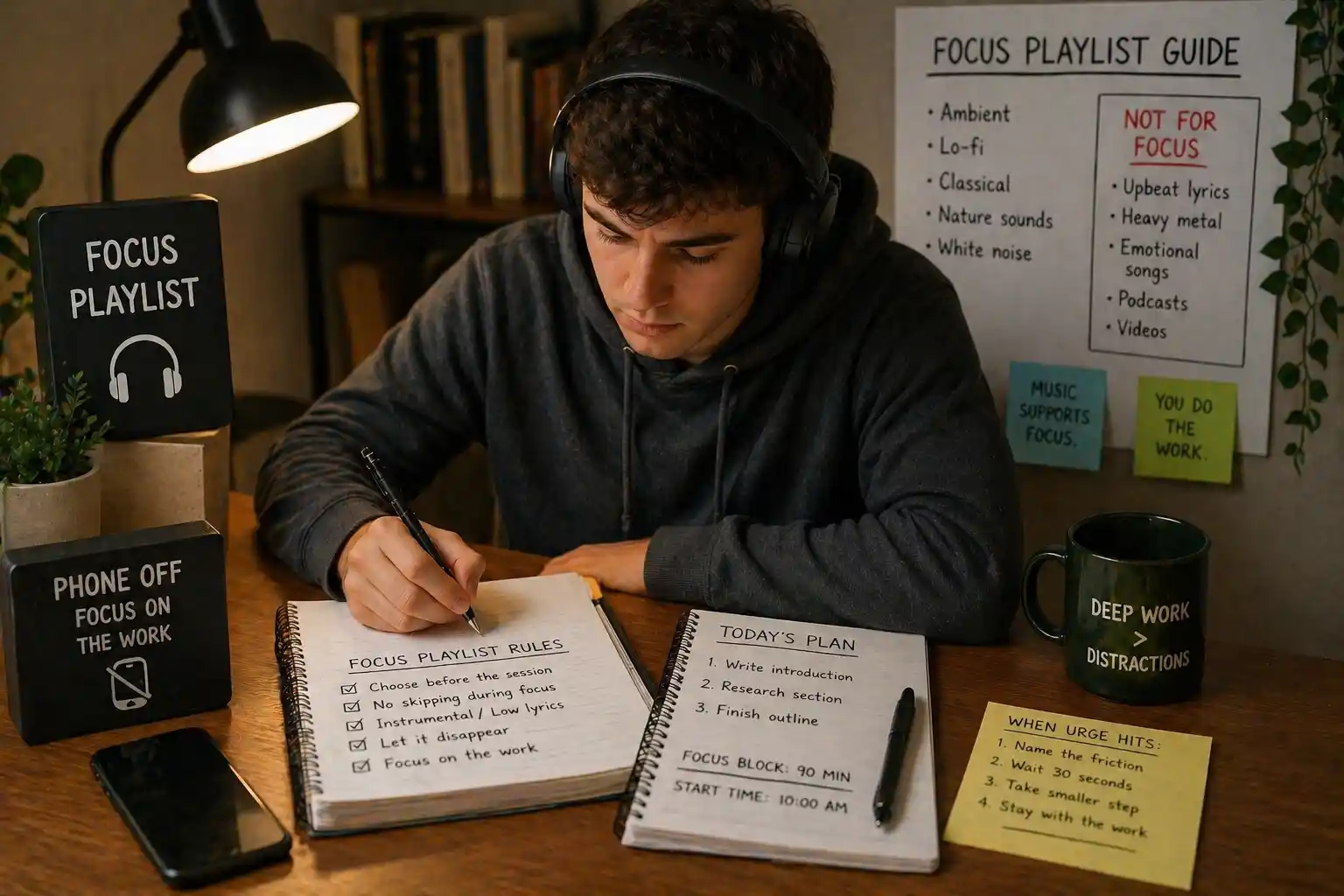

The Real Reason Studying Feels Heavy Before You Even Start
Most students who struggle with studying do not have a comprehension problem. They have a retrieval problem. Before a single page is read or a single problem attempted, they spend ten or fifteen minutes trying to reconstruct the situation: what was assigned, when it is due, where the notes from last class went, whether that important date is in the calendar or in a message somewhere.
This reconstruction is invisible work. It does not look like procrastination. It looks like organizing. But every minute spent searching for information is a minute not spent processing it. And the cumulative effect — rebuilding context at the start of every session, every day — adds up to a significant cognitive tax that arrives before the real work has even started.
I did not recognize this for a long time. I thought my problem was that studying felt hard. I tried harder playlists, better lighting, longer sessions, stricter discipline. None of it addressed what was actually happening: I was exhausting a portion of my limited daily mental energy on finding and reconstructing information that should have been immediately available. By the time I reached the actual material, I had already spent something I could not get back.
The one-notebook system is an answer to that specific problem. Not a system for organizing your academic life in a beautiful way. A system for making the first thirty seconds of every study session effortless, so all of the session's available energy goes toward learning.
Why Most Student Organization Systems Quietly Fail
Before describing what works, it is worth understanding why the alternatives tend to fail — not in theory, but in practice.
Apps and digital systems fail because they require maintenance. You have to remember to update them, check them, move tasks between sections, and sync information across platforms. They work when you are already organized. They become one more thing to forget when you are not.
Multiple notebooks for multiple subjects fail because they scatter the information that should live together. Your essay deadline is in the English notebook. Your math homework is on a sticky note. The question you wanted to ask about chemistry is in your phone. When everything is separated by subject, you can never see the full picture of what needs attention today.
Color-coded systems fail because the decoration becomes the activity. Students who color-code extensively often have beautiful notebooks with minimal useful information in them. The time spent formatting is time not spent thinking.
The one-notebook system does not compete with any of these. It is a single, deliberately unglamorous command center. One place where everything that needs your attention goes, in plain language, without decoration. Its power comes entirely from consistency — you use it every day, for every subject, without exceptions. The moment it becomes optional, it stops working.
What Actually Goes in the Notebook — and What Does Not
The notebook is not a second set of lecture notes. It is not a journal. It is not a creativity space or a brainstorming document. It has one job: to tell you what needs your attention, when, and what the next action is.
What goes in the notebook:
Assignments and their due dates — including the specific task, not just the subject and date.
The day's study plan — which subjects, which tasks, in which order and at what times.
Questions that appear during study sessions that cannot be answered immediately.
Things to follow up on — a clarification to ask the teacher, a concept to look up later, a task waiting on someone else.
End-of-day notes on what moved and what carries to tomorrow.
What does not go in the notebook:
Actual lecture content, formulas, definitions, or subject-specific notes — these belong in subject-specific documents or study materials.
Goals, ambitions, or long-term plans — these belong in a different kind of document, not here.
Long journaling entries or reflections — useful in their own right, but they do not belong in a system meant for quick reference.
The boundary matters. When the notebook becomes a place for everything, it becomes a place for nothing. It is useful precisely because it is narrow.
The Daily Study Page: Three Sections That Change How Sessions Begin
Each day gets one page. The page has three sections, and setting it up should take under five minutes — preferably the night before or first thing in the morning, not right before sitting down to study.
Section one: today's tasks.
Write the specific academic tasks that need to happen today. Not subjects — tasks. The level of specificity matters more than anything else in this section.
Weak task: "study biology." Strong task: "read pages 67 to 84 and write a three-sentence summary of each section."
Weak task: "work on essay." Strong task: "write the body paragraph on the economic causes of World War One — rough draft only, do not edit yet."
Weak task: "do math homework." Strong task: "complete problems 12 through 22 from chapter 7 — check answers against the back of the book after."
The specific version gives you a visible starting point and a visible ending point. The vague version gives you a category to inhabit without knowing when you have completed anything.
Section two: study blocks.
Write when you plan to do each task and for how long. Simple time assignments, not a rigid schedule. For example: "4:00–4:30 biology reading," "4:40–5:05 math problems," "7:00–7:30 essay paragraph."
Planning blocks in advance prevents the common pattern of sitting down to study, then spending fifteen minutes deciding what to work on first. The decision is already made. The session starts immediately.
Section three: notes for later.
A catch-all section for anything that surfaces during the day but does not need immediate action. A message to send. A question to ask. Something to check. An idea to come back to.
Writing these down prevents them from occupying mental space during study sessions. When a random thought appears mid-block, it goes here and is handled after the block ends — not during it.
Capturing Deadlines the Right Way: Task, Not Just Date
The most important deadlines to capture are the ones you receive and immediately feel you will remember without writing down. You will not. The confidence you feel in the moment of receiving a deadline is not correlated with whether you will remember it correctly three weeks later under different circumstances.
Write every deadline in the notebook immediately, with three pieces of information: the subject, the specific task required, and the due date. These three together are what you need. Any one of them alone is insufficient.
Subject only ("biology test") tells you what area is affected but not what you need to prepare.
Date only ("Friday") tells you when but not what for, and becomes meaningless after a few days when multiple Fridays have passed.
Task only ("multiple choice chapter 5") tells you the format but not when, so it has no urgency signal.
All three together: "Biology — chapter 5 multiple choice test — Friday the 14th." Now you have what you need to plan.
A useful addition is a "next action" line beside each deadline entry. Not a complete study plan — just the next action. "Next: re-read chapter 5 summary tonight" or "Next: find out how many questions are on the test." This converts the deadline from a pressure point into a sequence of solvable steps, which is a significantly different psychological experience.
The Confusion List: Turning Stuck Points Into Specific Problems
During study sessions, a running confusion list is one of the most practical tools available. It is also one of the least used.
Most students handle confusion by either stopping immediately to search for an answer (which interrupts the session and often leads somewhere unrelated), or mentally noting it and moving on (which means it is forgotten). Neither approach is effective. Stopping to search breaks momentum. Mental noting is unreliable.
The confusion list is a third option. When something is unclear, write it in the notebook in one specific sentence and continue the session. The confusion is captured without the session being derailed.
The specificity of the sentence matters. The more specific the confusion, the more resolvable it becomes.
Too vague: "I'm confused about photosynthesis." This cannot be looked up directly because it does not point at anything specific.
Better: "I don't understand why the light-dependent reactions need to happen before the Calvin cycle — specifically what the ATP and NADPH from the first stage actually do in the second." This can be answered with one targeted lookup or one precise question to a teacher.
Too vague: "Something about the French Revolution isn't making sense." Useless as a study target.
Better: "I can't remember whether the Estates-General was called before or after the financial crisis, and why that ordering matters." This is a specific factual question with a specific answer.
At the end of the study block, the confusion list becomes the agenda for the next round of research or for questions to bring to class. The confusions do not disappear into the background. They get solved, one specific entry at a time.
The Five-Minute Weekly Review That Prevents Surprise Deadlines
Once a week, spend five minutes reviewing the notebook's deadline entries against the coming week. This review has one purpose: to make sure no deadline is arriving without a study plan in place.
The pattern it prevents is the most common one in academic stress: you know the deadline exists, it lives in your notebook, but you have not moved any work into the daily schedule. The deadline arrives with the work undone, and it feels like a surprise even though it was written down weeks earlier. The weekly review is the step that converts "I know about this" into "I have planned when I will do this."
During the review, look at every deadline in the next ten days. For each one, ask: have I scheduled specific study sessions for this? If not, add them to the upcoming daily pages now, before the week begins. Three sessions of thirty minutes spread over a week are significantly less stressful than three hours the night before. The weekly review is what makes the spread-out approach happen reliably rather than as an occasional good intention.
The End-of-Day Review: Close the Loop Before Closing the Notebook
Before closing the notebook at the end of each day, spend three to five minutes with the day's page. This review has a specific structure, not a free-form reflection.
First, mark what was completed. A simple checkmark or cross. The visual record matters — it makes progress concrete instead of abstract.
Second, move anything unfinished to tomorrow. Not with guilt, not with new time estimates. Just moved. Write it on tomorrow's page in the tasks section with a small marker to show it carried over.
Third, scan the confusion list. Circle anything that still needs resolution. If something needs a question asked to a teacher, write a reminder in tomorrow's notes-for-later section. If something can be resolved with a brief lookup, add it to tomorrow's tasks.
Fourth, identify the most important task for tomorrow's first study block. Write it clearly at the top of tomorrow's page. When tomorrow begins, the starting point is already visible.
This review takes under five minutes and produces something valuable: you close the day knowing exactly where things stand. Not because everything is finished, but because everything has a place. The difference between "I have so much to do and I don't know where any of it is" and "I have these specific things to do and they are in the notebook" is a significant difference in how the evening and the following morning feel.
What Changes When Everything Lives in One Place
The most immediate change is at the beginning of study sessions. When the notebook contains today's specific tasks, a time plan, and a clear starting point for the first block, the session starts in under a minute. No searching, no deciding, no reconstructing. The decision work was done earlier, in a calmer moment, and it is waiting.
The second change is in how deadlines feel. Deadlines become manageable earlier. Because they are captured with specific tasks and regularly reviewed, they surface with time to prepare rather than arriving as surprises. The anxiety associated with deadlines is almost always a function of uncertainty — not knowing exactly what is required, how long it will take, or when you will do it. The notebook removes all three uncertainties systematically.
The third change is subtler. When confusion is captured specifically rather than vaguely, the material feels less overwhelming. A list of ten specific questions about a subject is psychologically much lighter than a general feeling that you do not understand the subject. Specific questions have answers. Vague confusion does not.
None of this requires a perfect notebook or a beautiful system. A plain notebook with clear handwriting and three sections per day is enough. The system works because it is simple enough to maintain every day, even when motivation is low — which is exactly when it is most needed.