Why Your Brain Interrupts You — Even When You Want to Focus
You sit down to study or work. Your phone is away, the desk is clear, the task is specific. And then, ten minutes in, your own mind derails you.
You remember a message you have not answered. You notice you need to buy something before tomorrow. A half-formed idea about a different project floats up. You think of a question you meant to look up last week. Each of these feels small, but each one carries the same silent threat: if I do not act on this now, I will forget it.
That urgency is not irrational. It is your brain's prospective memory system doing exactly what it was built to do.
Prospective memory is the cognitive system responsible for remembering to do things in the future — not recalling past facts, but holding intentions forward in time. Research shows that prospective memory reminders often surface at random moments because the brain cannot reliably predict when you will next be free to act on them. It interrupts you now because now is certain. Later is not.
This means the interruptions are not a discipline failure. They are a design feature. Fighting them with willpower alone — trying to push thoughts away and refocus — forces you to maintain the thought actively in working memory while also trying to work, which is genuinely costly and usually fails within a few minutes. The thought comes back because you never gave it anywhere to go.
The Prospective Memory Problem That Nobody Talks About
David Allen's Getting Things Done, published in 2001, built an entire productivity system around one insight: the brain is a bad storage device for open commitments. Every unresolved intention — every "I should remember to..." — occupies what Allen called "psychic RAM." The more open loops you carry, the more mental overhead you pay even when you are not actively thinking about them.
His solution was a trusted capture system: a single place where every open loop gets written down so the brain can release it. The logic was that the brain keeps recycling reminders partly because it does not trust that the thought has been saved somewhere reliable. Give it a reliable place, and the reminders stop competing for attention.
The distraction parking lot applies this same principle specifically to the focus session. It is not a full task management system. It is a temporary holding area for thoughts that appear during a block — a place specific enough that you trust it and small enough that using it takes five seconds.
The difference between a full GTD capture system and a parking lot is scope. A GTD inbox is meant to collect everything across your whole life and needs weekly review to function. A parking lot exists only for the duration of a single focus session. It gets emptied at the end of every block. That simplicity is what makes it usable under pressure, when a thought arrives mid-sentence and you need to act in five seconds or lose the thread of the work.
What a Distraction Parking Lot Actually Is
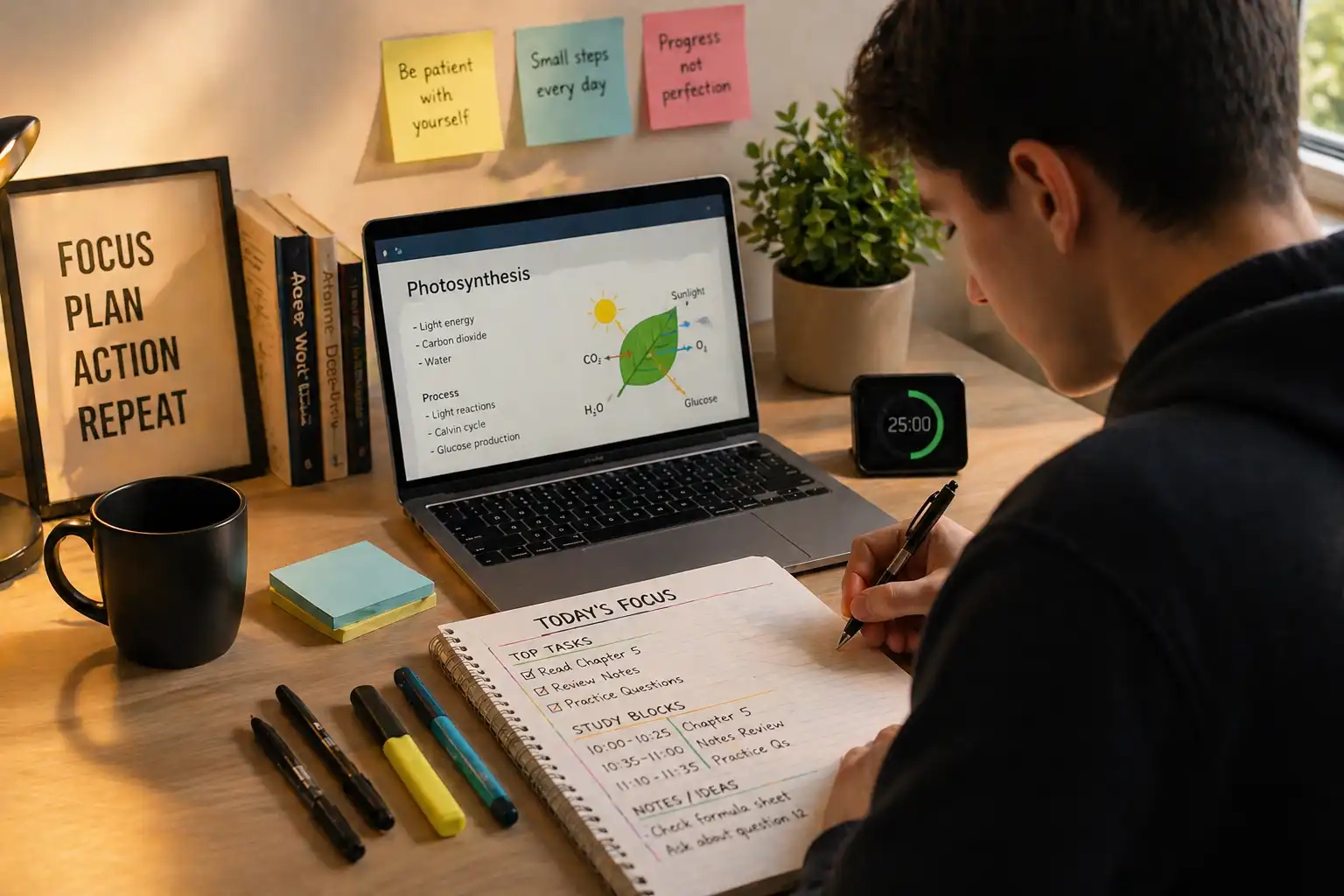
A distraction parking lot is a single, dedicated place beside you during a focus session. It can be a piece of paper, a notebook page, a sticky note, or a plain text file — whatever you can write in without navigating away from your work.
The rule is simple: when a thought appears that is not part of the current task, you write it down in three to seven words and return immediately to the work. You do not solve the thought. You do not investigate it. You do not open a new tab to handle it. You park it.
This sounds minimal because it is. The power is not in the system — it is in what happens inside your brain when you write the thought down. The brain, having received confirmation that the thought is captured somewhere reliable, reduces its urgency signal. The loop closes, at least temporarily. You can work.
The reason this works when willpower does not is that willpower tries to suppress the thought, which keeps it active in working memory. Writing the thought down is different — it is not suppression, it is delegation. You are not fighting the brain's reminder system; you are satisfying it.
The Five-Second Capture Rule
The most important rule for a parking lot is that using it must take five seconds or less. If using it takes longer, you will start making decisions mid-capture — "should I add detail here?" "should I also note the context?" — and those micro-decisions are exactly the kind of engagement that lets the thought expand and take over the session.
Five seconds means: write the minimum phrase that will let you recognize the thought later, then stop writing and look back at the work.
Examples of five-second captures:
- "reply to Anna re Thursday"
- "check assignment deadline — biology"
- "buy shampoo"
- "idea — outline structure differently"
- "ask about meeting reschedule"
- "look up — does sleep affect memory consolidation"
Each of these is enough to reconstruct the thought later. None of them require you to open another application, make a decision, or continue writing.
What breaks the five-second rule: opening a notes app instead of writing on paper (navigating costs attention), adding context that takes a full sentence, beginning to plan what you will do about the thought, or starting to evaluate whether the thought is worth keeping. All of that comes later, after the session ends.
What to Write and How to Write It
Three types of thoughts tend to appear during focus sessions, and each benefits from a slightly different capture style.
Intentions and tasks. These are the most common: things you need to do or remember later. Write these as actions, not topics. "Email professor" is clearer than "professor." "Pay phone bill" is clearer than "phone." The action form makes the thought easier to process later without re-interpreting what you meant.
Questions and research impulses. These arrive when your current work triggers curiosity about something adjacent — a term you want to look up, a claim you want to verify, a concept you want to understand more deeply. These are dangerous because they feel productive and subject-relevant, making it tempting to justify the detour. Write them as questions: "What is the spacing effect exactly?" or "Does cortisol affect working memory?" Then leave them on the list. If they are genuinely useful to your study, they belong in a planned research block, not as a mid-session rabbit hole.
Ideas about the current task. Sometimes the interruption is not a distraction at all — it is your brain generating something relevant. A better structure for the essay. A connection between two concepts. A different approach to the problem set. These are worth capturing, but they still need to be parked. Acting on them immediately means abandoning your current path before finishing it, which rarely produces better work than finishing the current direction and then evaluating the new idea with full attention.
Write these as brief notes: "idea — try argument structure flipped" or "connection — relates to Chapter 4 spacing concept." Then return to the task. The idea will be there when the block ends.
The Failure Mode: When the Parking Lot Becomes the Distraction
There is one consistent way this system stops working: the parking lot starts requiring thought to use.
This happens in several recognizable ways. You start writing full sentences instead of fragments, which means you are composing rather than capturing. You begin evaluating whether a thought is worth adding, which means you are making decisions during the capture moment instead of after. You start reviewing items you already wrote, which means you are pulling attention toward the list instead of back to the work. You create sub-categories on the list — tasks, ideas, questions — which means you are organizing during the session.
Any of these behaviors transforms the parking lot from a five-second capture into a competing focus object. Once that happens, the thought that arrives does not get parked in five seconds — it gets processed, and you have replaced one distraction with another that feels more legitimate.
The fix is structural: the parking lot needs to be visually separate from everything else you are working with, it must not require scrolling or navigation to reach, and the capture must always end with your attention returning to the original task. If you find yourself lingering on the list, treat that as a signal that the list is becoming a retreat from the hard work rather than a tool to protect it.
What Actually Counts as Urgent — and How to Be Honest About It
A common objection to any capture-and-park approach is that sometimes things are genuinely urgent and cannot wait. That is true. The parking lot is not meant to override genuine emergencies.
The problem is that the brain's urgency signal does not accurately distinguish between genuinely urgent and merely important-feeling. Something feels urgent if it is time-sensitive, emotionally charged, or involves another person — but most thoughts that arrive during focus sessions fail the actual urgency test when examined honestly.
A useful filter: ask whether the cost of acting on this thought in ninety minutes, at the end of the session, is meaningfully higher than acting on it now. For most thoughts, the answer is no. The email can wait ninety minutes. The errand can wait until the session ends. The idea about a different project will still be there after you finish this one.
The cases that actually cannot wait are narrower than they feel in the moment. A message from someone who physically needs you right now. A deadline that expires during this session. A safety issue. These are worth interrupting for — and they are rare enough that encountering one during a focus block is an exception, not a pattern.
Everything else can be parked. The test is not "does this feel urgent" but "is acting on this right now worth the cost of abandoning the current task's context." The cost of interruption is not zero. Research on task-switching shows that recovering full context after an interruption — returning to the same depth of engagement you had before the break — takes several minutes on cognitively demanding work. A thought that takes thirty seconds to act on may cost four minutes of recovery. That math should change how you evaluate urgency.
Emptying the Parking Lot After the Session
At the end of every focus block, the parking lot needs to be reviewed and cleared. This step is not optional — if you carry items over from session to session without processing them, the list stops feeling trustworthy, and an untrustworthy list loses its value as a capture location.
The review should take five to ten minutes and follow a simple sequence. Go through each item and ask: does this still matter? If no, cross it off. If yes, decide where it belongs.
Tasks go into whatever task list you actually use. Calendar events go into the calendar. Questions worth researching go into your study notes or a research list. Ideas get one sentence in an idea file. Thoughts that no longer seem important get discarded.
One of the most valuable things you will notice during this review is how many items that felt urgent during the session feel minor or irrelevant fifteen minutes later. This is not because the thoughts were worthless — it is because urgency is partly a function of timing and emotional state. A thought that arrives when you are trying to concentrate carries an inflated sense of importance because your brain is looking for reasons to stop doing something hard. Distance deflates that inflation and shows you what actually needed attention.
After the review, the parking lot should be empty. Start the next session with a blank page.
What Changes After You Use This for a Week
The most commonly reported change is that focus blocks feel calmer — not because fewer interrupting thoughts arrive, but because the response to them changes. Thoughts arrive, get captured, and stop pulling. The mental loop closes in five seconds instead of escalating into a detour.
A secondary change is that you start to see your own distraction patterns clearly. After a few days of keeping parking lots, the list will show you what kinds of thoughts reliably pull your attention during difficult tasks. For many people, it is social obligations — unanswered messages, plans that feel unresolved. For others, it is adjacent research impulses that feel productive but fragment the main work. For others, it is low-stakes tasks that are easy to do and give a quick sense of completion when the actual work is hard. Seeing the pattern is more useful than any productivity advice, because you can target it specifically.
The deeper shift is behavioral. Over time, the brain learns that thoughts will be captured, not lost, and that acting on every impulse immediately is not necessary for survival. That learning is slow, but it does accumulate. People who use systematic capture habits consistently report that the urgency of interrupting thoughts decreases over weeks — not because they are suppressing anything, but because the brain has revised its model of what "I need to act on this right now" actually means.
None of this requires a complex system. A piece of paper beside your keyboard and a five-second write-and-return habit are enough to start. The system works not because it is sophisticated, but because it solves the right problem: the brain's need to trust that open loops will not be forgotten.