
The First 15 Minutes Were My Weakest Part
I used to think my focus problem happened in the middle of work. I thought I lost attention after getting tired, bored, or distracted. But when I paid closer attention, I noticed something more annoying: a lot of my work sessions were already damaged in the first 15 minutes.
I would sit down, open the laptop, and then kind of float. Not completely waste time, but not really start either. I would check email "just to clear my head." I would open a browser tab. I would look at my task list. I would adjust the music. I would maybe clean one tiny part of the desk. Then somehow the clean start was gone.
The strange thing is that I usually had work to do. The problem was not that I had no tasks. The problem was that the first action was not obvious enough, and by the time I sat down, my environment had already started making suggestions of its own.
That is when I started using what I call a before-you-sit-down note. It is almost embarrassingly simple, but it fixed a very real problem for me.
Why Sitting Down Is Already Too Late: The Prospective Memory Problem
When you sit down without a clear first move, your brain starts negotiating. It asks small questions: should I check messages first? Should I review yesterday's notes? Should I open the task app? Should I see if anything urgent happened? None of these seem dangerous. But each one creates a small opening for habitual distraction to enter before intentional work begins.
There is a specific cognitive mechanism behind this. Psychologists studying prospective memory — the ability to remember to perform an intended action at a future moment — have found that these intentions are highly vulnerable to environmental interference. When you form a goal ("I will work on the report when I sit down"), that intention competes at the moment of action against whatever the environment is already cueing. If your laptop is associated with a habitual sequence of opening email and scanning notifications, that sequence has a head start. It does not require a decision. Your intention does.
The problem is made worse by the fact that sitting down at a work surface is not a neutral event. The screen, the open tabs, the notification indicators — each is a competing stimulus that activates before your conscious intention has had a chance to assert itself. By the time you are registering what you intended to do, the email is already open.
The note does not fix willpower. It removes the need for willpower at that exact moment by providing an environmental cue that is stronger than the competing ones. You see the note before you see the screen. The note wins the first move.
The Before-You-Sit-Down Note
The note has only three lines:
Open this first:
Do this before anything else:
Do not touch this yet:
That is it. Not a full plan. Not a beautiful checklist. Not a productivity dashboard. Just three lines that protect the beginning of the session by answering the three questions your brain will ask when it sits down.
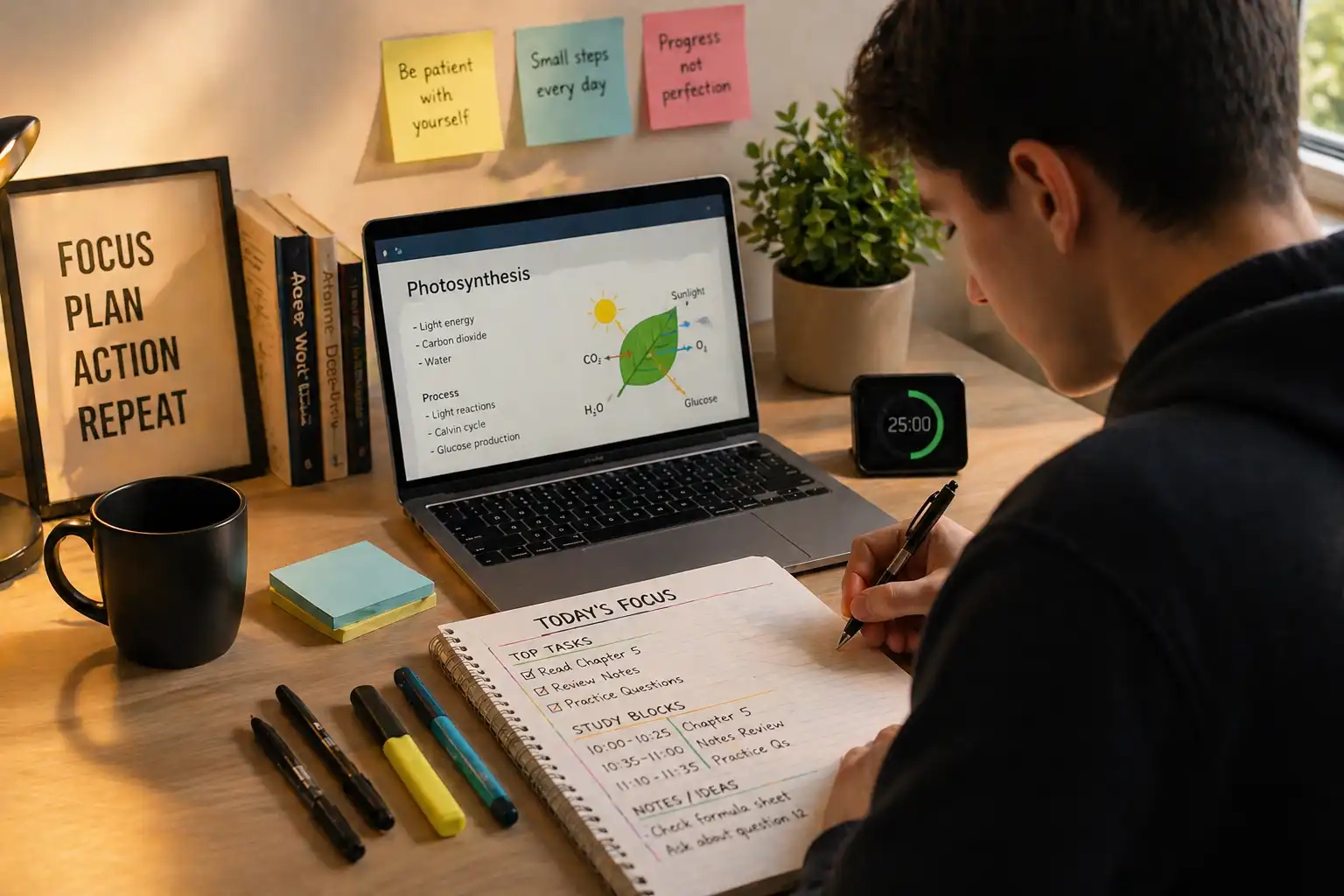
I write it on paper, because paper does not come with notifications or competing content. A sticky note or a plain text file works too, as long as it does not send you into another app or inbox before you have made the first move.
The note is written before sitting down — ideally at the end of the previous session, or during a natural pause before the work begins. The timing matters. Writing it from a calmer position, before the environment starts making its own suggestions, produces a better note than deciding at the desk.
Line 1: Open This First
The first line removes the most common starting question: where do I begin?
Write the exact thing you should open first — not the general project, the exact file, page, notebook, chapter, or document. The specificity is what makes it work. "Work on the essay" is a goal. "Open the essay draft, paragraph three" is an implementation intention. These feel similar but function very differently at the moment of action.
Examples:
Open this first: essay draft, third paragraph.
Open this first: biology notes, chapter 4 summary.
Open this first: client report document, section two.
Open this first: math worksheet, question 6.
Open this first: article outline, intro section.
This saves more mental energy than it seems. You do not sit down and browse your own work looking for the right entry point. You sit down and navigate directly to the starting surface. That difference, accumulated over many sessions, changes how much of the first 10 minutes reaches actual work.
Line 2: Do This Before Anything Else
The second line commits you to one action before email, messages, cleaning, or "quick checking."
The action should be small enough that you can start it even on a low-motivation morning. It is not a promise about the whole session. It is only a commitment about the first move.
Examples:
Do this before anything else: write one rough paragraph.
Do this before anything else: solve the first two problems.
Do this before anything else: review notes for 10 minutes without adding anything.
Do this before anything else: list three main points for the report.
Do this before anything else: rewrite the one sentence that felt wrong — not the whole section.
The phrase "before anything else" does the behavioral work. It is a pre-commitment, made when you are not yet under the influence of competing stimuli, about what the session will prioritize. That pre-commitment is substantially more reliable than a decision made at the moment of action.
Line 3: Do Not Touch This Yet
The third line names the specific escape route you are most likely to use.
This line works because distraction is usually predictable. You already know, before you sit down, what you are likely to use as a detour. It might be email, YouTube, social media, Slack, phone, or even productive-seeming things like reorganizing files or reading one more background article. The difference between knowing this and naming it explicitly is that naming it removes the automatic quality of the behavior.
Examples:
Do not touch this yet: email.
Do not touch this yet: YouTube explanations.
Do not touch this yet: Slack or messaging apps.
Do not touch this yet: phone.
Do not touch this yet: document formatting.
Do not touch this yet: researching a better example.
This is not a ban. It means "not before the first action." That constraint feels manageable. It is specific enough to be actionable and limited enough not to feel punishing.
A Real Example From a Messy Morning
Here is one real version of the note I used when I felt stuck on an article:
Open this first: article draft — section about fake research.
Do this before anything else: write 5 ugly bullet points for that section.
Do not touch this yet: Google search.
That morning, I badly wanted to research more. It felt like the responsible choice. But I also knew the draft already had the information it needed. What it did not have was movement. The section was blank, and a blank section is not a research problem — it is a starting problem.
So I wrote five ugly bullet points. They were not good. One of them was clearly off-track. But after writing them, the section was no longer empty. That changed the feeling of the task entirely. Research became easier to manage because I was researching for a draft that existed, not hiding from a blank page.
Another version, for a study session:
Open this first: biology notes, chapter 4 summary.
Do this before anything else: read the summary and mark two things I do not understand.
Do not touch this yet: YouTube explanations.
The note does not replace studying. It removes the three most common reasons the first 10 minutes disappear before studying begins.
Why This Note Works: Implementation Intentions and Pre-Commitment
The psychological mechanism behind the note has been studied systematically. Peter Gollwitzer, a psychologist at New York University, spent decades investigating why people often fail to act on goals they genuinely intend to pursue. His central finding was that the problem is rarely motivation — it is specificity. People set goal intentions ("I will work on my project today") but fail to form implementation intentions ("When I sit down at 9am, I will open the draft and write the introduction").
In a meta-analysis of 94 studies, Gollwitzer found that forming specific implementation intentions — specifying when, where, and how you will act — nearly doubled the rate at which people followed through on their goals compared to setting general intentions alone. The effect held across many domains: health behaviors, academic performance, and workplace tasks.
The before-you-sit-down note functions as a three-part implementation intention. Line 1 specifies what to open (the "when" cue and the "where"). Line 2 specifies the first action (the "how"). Line 3 pre-commits to avoiding a named escape route (a negative implementation intention — "if I want to open email, I will wait until after the first action").
The timing of writing the note also matters in a way that goes beyond habit. Decisions made before a stimulus context (before sitting down, before the screen is on) are less subject to the pull of the environment than decisions made inside it. Writing the note at the end of the previous session, or during a break, means you are making the choice from a position with fewer competing signals. That note then becomes an environmental cue that is stronger than the ones the screen provides — because it answers the first questions before the screen gets to ask them.
When This Lifehack Fails
This does not work if you make the note too elaborate. I tried turning it into a full mini-plan at first — five lines, sub-bullets, priorities — and that turned the note into another task. The note should take under two minutes to write. If it is taking longer, it has become something else.
It also fails if Line 2 is too ambitious. "Finish the report" is not a first action — it is a project. "Write the rough intro paragraph" is better. "Study chemistry" is a category. "Review one diagram from chapter 4" is an action. The specificity that makes Line 1 work is the same specificity that Line 2 requires.
And it fails when Line 3 is written but ignored. If you write "do not touch email yet" and immediately open email, the note cannot do anything. The note is a cue, not a lock. It helps when you notice it and follow it. When it is ignored, it becomes just another note that was never acted on.
The goal is not a perfect session. The goal is to make the first genuine action more accessible than the first habitual distraction.
Make the First Move Before Your Brain Starts Negotiating
Gollwitzer's research makes a point that the before-you-sit-down note illustrates: the gap between intending to do something and actually doing it is not primarily a motivation gap. It is a specificity gap. You need to know not just what you want to accomplish but where, when, and how the first action will happen — and you need that information externalized before the environment starts competing for your attention.
Before your next session, write the three-line note:
Open this first.
Do this before anything else.
Do not touch this yet.
Write it before you sit down. Keep it visible when you do. Then follow only that — not the whole day, not the whole plan, just the first move.
Focus does not begin at the moment of inspiration. It begins at the moment the first action is made clearer than the first distraction.